 ewsba.se
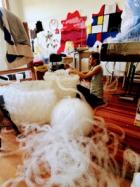
Artist Emilie Dundee Odeile has exhibited at a state-subsidised arts project in Trinidad, Colorado Courtesy Dundee & Lee
“Affordability” is on the lips of every American. In Colorado, over 35% of residents spend more than 30% of their income on housing, which is considered a cost burden by the US Department of Housing and Urban Development (Hud). The state is responding by allocating $300m annually to the State Affordable Housing Fund. A niche area of this investment is the development of affordable housing for artists and creative districts.
National non-profits such as Artspace and the Community Arts Stabilization Trust (Cast) arrived in the state recently, participating in the many funding programmes supporting this effort. Both non-profits market affordable housing for artists, but in the absence of artist certification programmes such as those in Boston, New York and now San Francisco, restricting available affordable housing to artists could run the risk of violating fair housing laws. There are also few mechanisms for cities and states to ensure their public funding delivers long-term solutions for artists’ housing and creative spaces.
“We were floored,” artists Emilie Dundee Odeile and Ken Lee Chapin tell The Art Newspaper, when their work Goodnight Moon: A Fiber Tale drew more than 10,000 visitors to Trinidad, a town of 8,000 people near Colorado’s southern border. The artists used around 152 miles of yarn to bring the famous children’s book to life in a 2023 exhibition.
“We started our RV-life, one-year road trip experiment,” Chapin says. “We were on our way to Santa Fe, and went through Trinidad”—and they never left. Goodnight Moon and another project by Odeile debuted at Space to Create, a state-led initiative to produce creative workforce housing and studios in rural Colorado.
Trinidad was the first municipality identified by the Colorado Office of Economic Development and International Trade (OEDIT) for public investment through the establishment of a creative district, in 2015. Today, 37 creative districts exist across the state. Next door to Space to Create on Trinidad’s historic Main Street, Artspace manages residences for artists.
Artspace develops and operates workforce housing across 23 states, including seven projects in Colorado. Each project markets itself “for those in the creative sector” and offers residential space that “prioritises creative use”. But without a formal certification programme to identify artists in Colorado or any of the local municipalities it operates in, it is unclear how Artspace can legally give preference to artist applicants over members of the general public.
Poet and editor Michele McDannold lived in Artspace’s complex in Michigan City, Indiana, for nearly four years and at the organisation’s Honolulu location for seven months. She arrived in Trinidad in 2020, but noticed a substantial difference in the artist preference process at that location compared to the properties she had been in previously. In Michigan City, she says, “I had to give a presentation to a board of practicing artists and participate in an interview.” In Trinidad, she was only asked to submit information for income eligibility. McDannold has only encountered five artists across the property’s 40 units during her three-year stay. The result of not prioritising artist applicants appeared to be that there were almost no artist residents.
“When it came time to organise or participate in something like [open studios or a gallery night],” McDannold says, “neighbours were like, ‘What? Why are you bothering me?”
Artspace did not respond to The Art Newspaper’s multiple requests for comment. The Artspace Trinidad leasing office stated that it does not track the number of artist residents at that location.
Affordable housing is a broad term that lives on a spectrum of interpretation and regulation. According to the federal government, household affordability is based on the regional or area median income (AMI). What a property owner can charge a tenant is determined by Hud’s AMI calculations, but a lender can set the contractual terms of the tax credit, loan or grant, whether private or public. Under US Treasury regulations, a housing unit generates a low-income housing tax credit (LIHTC) only if it is available for general-public use. However, in 2008 the Housing and Economic Recovery Act added a provision to the Internal Revenue Service’s tax code stating that general-public use is not violated if preference is given to tenants involved in artistic or literary activities. Even so, some cities maintain their own artist certification programmes for affordable housing.
A 2023 affordable housing audit by Denver’s Department of Housing Stability expressed concerns that priority access to housing could violate the federal Fair Housing Act. While the report specifically focused on the Denver city council’s move to prioritise displaced households or people at risk of displacement, it highlighted the fact that prioritising seniors and veterans also requires better systems for monitoring and evaluation. Each time a person, such as an artist, is prioritised for affordable housing access, the county must track data such as the number of units allocated, eligibility requirements, types of document accepted as evidence of eligibility, the selection process, and the parties responsible for implementation and monitoring the property and rent levels.
Municipal governments are concerned about incurring fair housing lawsuits, especially if state and county laws contradict or fail to reaffirm the 2008 tax code revision. Cities considering allocating affordable housing units for artists can be faced with having to develop significant compliance procedures. This patchwork of rules, requirements and compliance regimes helps explain why creating and maintaining affordable housing for artists can be very complicated, costly, and look different in different cities and regions. According to the Center for an Urban Future, US cities have created just 2,804 units of dedicated housing for artists in the last decade.
The soaring windows of 210 East Street in Trinidad must have caught the eye of the developer Dana Crawford when she first visited the elegant century-old school building. Crawford, who died in January 2025, was a celebrated preservationist in the region, known for saving Denver’s historic Larimer Square and redeveloping the city’s Union Station. There were minimal requirements attached to the $4m community revitalisation grant Crawford received for the redevelopment of 210 East Street into 17 affordable live-work spaces for artists. An open records request reveals the terms of the grant for the property only ask for progress reports on the number of housing units and jobs created.
The Former East Street School building in Trinidad, Colorado has been converted to housing and marketed as affordable for artists, among others Photo: Community Arts Stabilization Trust
For the 210 East Street project, Crawford procured three different tax credits, the $4m community revitalisation grant and $1.8m in private financing, but the most restrictive terms were attached to last-minute funding from the city of Trinidad. In 2022 Crawford applied to the city’s Housing Now incentive programme to help cover the $125,000 cost of redesigning five units. The city approved the request on the condition of a two-year workforce housing deed restriction, requiring rent rates to be limited to 80% of AMI starting in 2023.
Crawford also sought $1.9m in funding from an impact investor, Greenland CDF. The funding from Greenland was contingent on signing a Community Benefit Agreement (CBA), a binding contract that requires the borrower to produce a social benefit with enforceable penalties. The details of the agreement are not public and expired earlier this year.
Less than five years after Crawford received a total of $7.5m in public funding for 210 East Street, the property was acquired by Cast. There are no existing public terms that legally require Cast to deliver affordable housing to artists, or even general housing.
Cast operates a non-profit real estate development strategy around creative spaces and affordability. Recently, the organisation expanded that strategy to housing in Colorado.
“Our model as a non-profit is to reset the floor of affordability,” says Ken Ikeda, Cast’s chief executive. “If we could do that without debt, through grants, then that would keep it that way in perpetuity.”
Currently, Ikeda adds, Cast is only required to deliver the private terms of the $1.9m grant the organisation received from the Colorado Health Foundation to acquire 210 East Street. Rent at the complex is currently between 55% and 80% of AMI, and according to a spokesperson for the organisation, five current residents are artists. The Art Newspaper was only able to verify that one resident is an artist, and that person said they know of no others.
Half a mile from 210 East Street are three properties that have received significant public funding in exchange for affordable artists’ housing. In 2019 ownership of two addresses on Main Street and one on Elm Street were transferred to Artspace by the city of Trinidad. In exchange for that real estate and a $715,000 promissory note by the Colorado Housing Finance Authority in 2022, Artspace must deliver housing units within or below 40% to 60% of AMI for 35 years, and preserve the historic facade of the Main Street properties for 15 years. If it fails to maintain this commitment, it must repay the borrowed funds.
The vastly different requirements for the Artspace and Cast properties in Trinidad, and the strings attached (or not) to their public and private funding reflect the wildly different standards and requirements for organisations creating and operating affordable artists’ housing.
The 444 17th Street building in Denver, the future site of a multi-use affordable housing and cultural hub for artists, to be operated by Community Arts Stabilization Trust Photo: Community Arts Stabilization Trust
A vibrant art and culture scene boosts local businesses and helps create jobs, according to the Denver Downtown Development Authority (DDDA), a city initiative to revive a downtown core where the vacancy rate has remained at or above 30% since the Covid-19 pandemic. In 2025 and 2026 the DDDA awarded $114.5m in financing for new housing and $4.45m for art-related initiatives—including a $1.35m grant to Cast to convert 6,300 sq. ft of vacant office and retail space into affordable artists’ studios, a cinema and gallery. The city council approved the terms of the property’s sale to Cast in September.
“We are going to make it affordable no matter what, because that is our aim and objective,” Ikeda says of the project in Denver, which has been vacant since 2021. Cast estimates the art space will open in the summer of 2027.
Representatives for the city did not clarify how it defines “affordable” in the context of commercial real estate, but noted that the city has the first right to purchase the property for $1 for the next ten years if Cast decides to sell. In the meantime, municipal support will be released in phases as Cast reaches a series of build-out milestones.
While Denver finds its footing on affordable housing for artists and New York has not added any units in a decade, San Francisco’s first dedicated affordable artists’ housing is on track to open in 2028. The Artist Hub on Market, at 1687 Market Street, will have 94 units of housing, rehearsal space and a theatre. Rent will be set between 30% and 80% of the AMI, depending on the size of the unit and number of occupants, which equates to annual income of between $46,440 and $167,120 for tenants.
A rendering of the future Artists Hub on Market project in San Francisco Courtesy Artists Hub on Market and Mercy Housing California
Launching alongside the Market Street property is a new artist certification programme for San Francisco, facilitated by the Mayor’s Office of Housing and Community Development. Artists can achieve certification by documenting at least $10,000 in annual income from their art practice, showing proof of a public art commission or grant in the previous three years, or submitting a portfolio of work for review. Once certification is awarded, artists can enter the lottery for units at Artist Hub on Market; any units unclaimed by artists in the lottery will be opened to general-public use through the city’s affordable housing system.
Of the Artist Hub on Market project’s $140m in funding, $100m came from a single anonymous donor and, according to a source familiar with the terms of the deal, implementing the artist certification programme was a condition of the funding.
The inconsistent regulation of properties that receive public funding for affordable artists’ housing and cultural spaces risks undermining such projects’ longevity and disappointing the communities they were meant to serve. Recently, a $400,000 low-interest loan from the DDDA to Denver Immersive Repertory Theater (Dirt) went into default after Dirt’s alleged failure to make rent payments less than a year after it was awarded the loan and before its project ever opened to the public. According to reporting by Denverite, the loan’s rate surges from 3% to 15% when loan proceeds are shown to not be used for their intended purpose, though it is unclear what assets the city will be able to claw back from the project’s founders.
Affordable housing for artists is an emerging sector entangled with various local governments’ goals, which include attracting business, lowering housing costs by adding units and retaining creative workers. Ikeda describes every affordability project as a funding “butterfly” due to the unique risks and complexity of the capital and terms assembled. But, he adds, they are worth the trouble: “There is something magical about artist-only housing and live-work environments.”