 ewsba.se
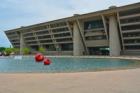
The campus of the modernist Dallas City Hall, built in 1978 and designed by I.M. Pei, includes Marta Pan’s Floating Sculpture (1973, foreground) Photo: D Guest Smith, via Alamy Stock Photo
When the mayor of Dallas, Erik Jonsson, inaugurated I.M. Pei’s city hall in 1978, he called it “a monument to the city’s pride, a symbol of a first-class city that’s reaching for greatness”. The seven-storey inverted pyramid slopes over a large plaza with site-specific sculptures like Henry Moore’s Vertebra in Three Pieces (1978, also known as The Dallas Piece) and Marta Pan’s Floating Sculpture (1973), which sits in a reflecting pool.
Since early 2025, the current Dallas mayor Eric Johnson and city manager Kimberly Bizor Tolbert have pushed to abandon and sell Pei’s city hall to private developers. They have cited the prohibitive costs of renovating the building, which ballooned within a matter of months from $81m according to an initial estimate for a basic infrastructure upgrade to $1.4bn for massive upgrades over two decades.
In recent interviews, Johnson has sounded far different from his predecessor. He has called the building “obsolete”. Architecturally significant or not, moving the municipal headquarters “would make this location available for development, which I would also support. I believe that will be a very, very big part of the future of downtown and its revitalisation.” Spokespersons for the city did not respond to The Art Newspaper’s questions.
The current mayor is in alignment with the “Say Yes to Downtown” campaign group led by former mayor Mike Rawlings. With developers and other former leaders, the campaign argues that city hall must be demolished to create an entertainment district, including a new arena for two of the city’s professional sports teams, the Dallas Mavericks basketball team and the Stars hockey team. When the teams announced plans to move out of the city’s core, both considered relocating to the city hall site. They ultimately chose other locations.
Amid the uproar over the possible demolition of Pei’s modernist complex, few have questioned the fate of Pan’s and Moore’s sculptures. Both were gifted to the city and are part of the municipal public art collection. But the future of Moore’s, which has required previous renovation, in part with help from the artist’s London-based estate and foundation, is a particular concern. The large grouping of organic forms was meant to complement Pei’s rigidly angular structure. It was also a gift to the city from the philanthropist W.R. Hawn in memory of his wife Mildred Hawn, whose favourite sculptor was Moore. Both sculptures are part of the preservation plan for the building; representatives for Moore and Pan’s estates did not respond to The Art Newspaper’s inquiries.
Dallas City Hall The Lyda Hill Texas Collection of Photographs in Carol M. Highsmith's America Project, Library of Congress, Prints and Photographs Division.
The non-profit Save Dallas City Hall, an ideologically diverse grassroots coalition, has been among the loudest voices opposed to moving the facility. It is led by president Bruce Richardson, a musician, artist and former political candidate, and vice-president Zaida Basora, an architect and former city employee who oversaw maintenance of properties, including city hall, and currently serves as the executive director of the American Institute of Architects Dallas.
Basora and her colleagues have proposed a ten-year phased plan that, even factoring in inflation, is estimated to cost between $70m and $100m, and would not require municipal staff to move. The cost of simply demolishing the building—to say nothing of the expense of building something in its place—has been estimated at $60m.
The Dallas city council gave Tolbert a deadline of 26 August to present relocation options for city hall, which she missed. Inflation has also increased the cost of relocating. The same month, Save Dallas City Hall sued the city, arguing that it was committing “demolition by neglect”.
“Dallas city hall has at least one failed generator, active parking garage leaks and is due for roof maintenance,” Richardson said in a statement. “Instead of tackling these problems with millions in available funds, the city halted repairs, wasting money and time to explore a move.”
On 2 October, the Save Dallas City Hall coalition started an effort to gather signatures to create a ballot referendum on the fate of city hall, which would be put to residents for a vote in May 2027. In early November, the group announced it had gathered around 25,000 signatures—well over the minimum 20,000 signatures needed for a ballot referendum. If the group’s proposed amendment to the city charter passes next spring, the municipal government will be required to continue operating from Pei’s city hall.
During elections earlier this month, 56% of Dallas voters opposed a $443m bond package. That package had included funding to move emergency operations out of city hall, which, according to advocates of preserving Pei’s building, would have been a first step toward abandoning it.
For the local activist Stephanie Drenka, a co-founder of the Dallas Asian American Historical Society who has spoken at nearly every public hearing since she learned of the building’s significance, preserving city hall is essential to recognising Pei’s contribution to Asian American history.
“The stakes are beyond our city alone,” she says. Less than 1% of historic markers in the US acknowledge the contributions of Asian Americans, according to the national non-profit Asian & Pacific Islander Americans in Historic Preservation.
“This also makes demolition of city hall an issue of further erasure of Asian Americans in history,” Drenka says. “It’s not just Pei’s legacy, but we’re defending ourselves. Everything in our community is embodied in this building.” She adds: “If we can’t save city hall then what threat can we stop?”