 ewsba.se
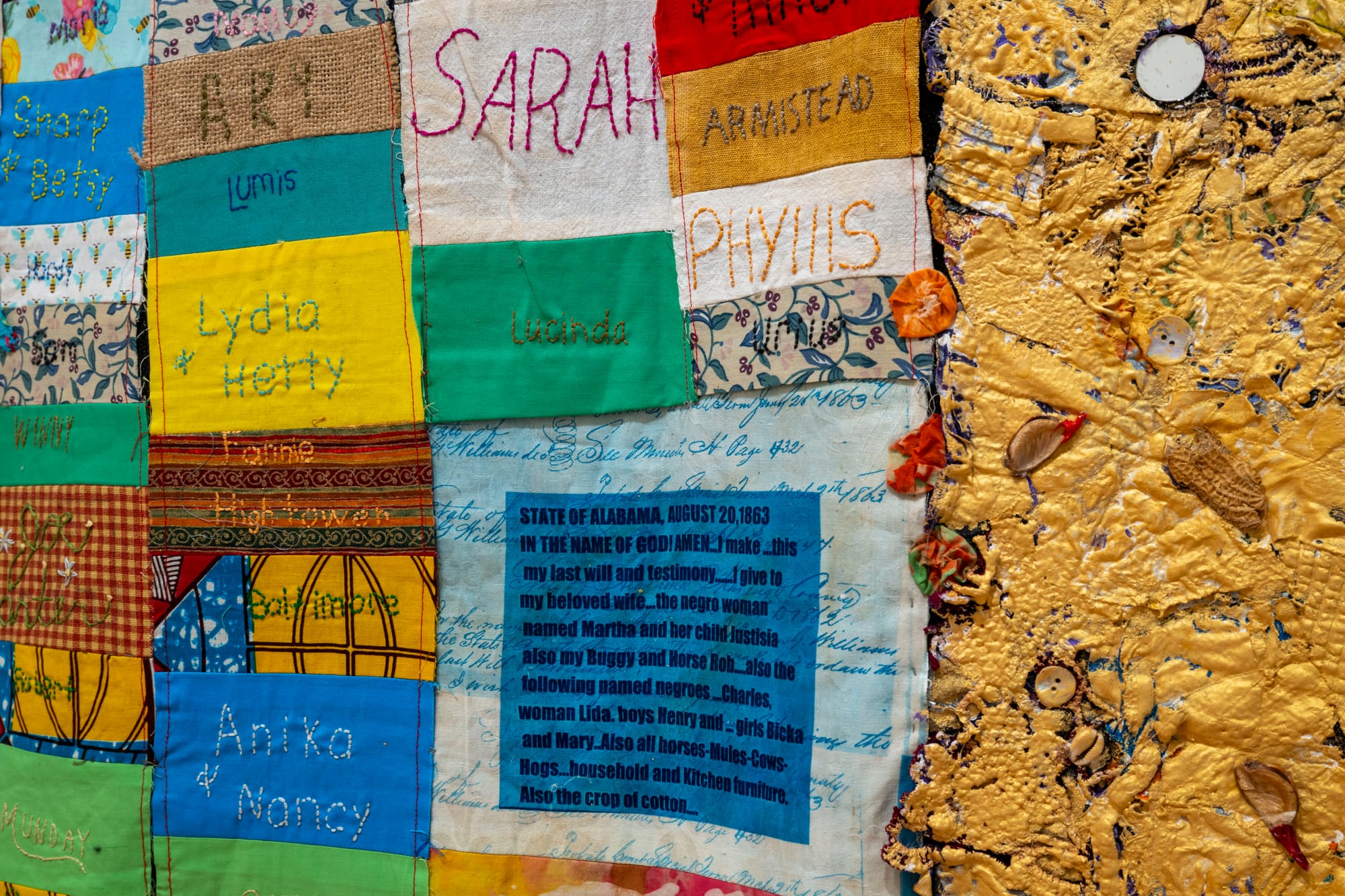
In a community center across from Mt. Willing Baptist Church, a group of women is sewing the legacies of enslaved people into their quilts.
AUBURN, Alabama — In Lowndes County, Alabama, less than an hour from Gee’s Bend, a group of women meet weekly to quilt together in a community center across from Mt. Willing Baptist Church. In 2021, they began to carefully stitch the names of formerly enslaved congregation members into their work. What started as a project to preserve and commemorate these forgotten figures of history soon grew into a broader collaboration across Alabama.
Sew Their Names: Quilting, Creativity, and Activism at the Jule Collins Smith Museum of Fine Art at Auburn University culminates a three-year partnership between the university and the Hopewell Project. The exhibition showcases a series of handmade quilts by Yvonne Wells, Wini McQueen, and Mercedes Braxton, alongside fellow Lowndes County artists including Bill Traylor, Noah Purifoy, and Charlie Lucas, highlighting the region's rich artistic tradition.
“A lot of the time, when institutions are trying to connect with communities, they’re parachuting artists into a place that already has art and culture there,” Randi Evans, the former Manager of Public Practice and Community Partnerships at the Museum, explains. “We were really cognizant of our role, to work away from that narrative and work in collaboration with what was already happening at these sites.”
A transplant herself, Evans hoped to learn about the traditions of Southern artists when she attended the quilt symposium “Every Stitch a Story,” hosted on Auburn’s campus. After Evans heard about the “Sew Their Names” project through a presentation by Judge Susan Walker, she thought it might be a good fit for the Museum in Motion initiative at the Jule. Previously, this initiative supported the 2022 exhibition Spell, Time, Practice, American, Body: The Work of RaMell Ross; Evans herself spearheaded partnerships across Hale County, where Ross’s film Hale County This Morning, This Evening (2018) was made.
Workshops at Auburn University's Rural Studio, November 2024 (both photos Mike Cortez)
“Since Auburn is a land grant institution, we see that part of our mission is taking the museum beyond our walls and reaching out to other parts of the state,” says Christy Barlow, the Museum’s Assistant Director of Education, Engagement, and Learning. Supported by resources from the Jule, “Sew Their Names” traveled around the state, pairing a showcase of quilts by commissioned artists with a series of workshops that allowed community members to participate in the quilt-making process.
The first workshop took place in November 2024, as the exhibition traveled to Hale County, where Auburn’s Rural Studio, an off-campus architecture program focused on rural housing development, is located. The quilts were exhibited at a variety of local venues — what Evans termed a “quilt trail” — including Newbern Library, a project by Rural Studio; Sumac Cottage, an art gallery in Greensboro; and the Safe House Black History Museum, which foregrounded the exhibition’s focus on historical reckoning.
The exhibition then traveled to the Project Threadways Symposium in Florence, Alabama. Founded by designer and textile artist Natalie Chanin, the symposium’s 2025 edition focused on food, clothing, and shelter. The symposium also hosted a quilt-making workshop at the Kennedy-Douglass Center for the Arts in Florence. “Part of the experience of the Mt. Willing quilters is that they also sing as they work,” explains Barlow, who attended many of the in-person workshops. “So the singing is happening, and you have people scattered all throughout this historic house, sewing, learning to sew, learning about this story.”
By early 2026, the exhibition made its way back to the Jule for a more permanent place in the main gallery; as Barlow explains, this is an unusual trajectory for a curatorial project. “Most of the time, the curatorial side develops an exhibition, and then education responds to it,” she says. “However, this was a Museum in Motion initiative which eventually led to an exhibition. When you work that way, you have more input from community voices, who are part of the conversation from the very beginning.”
Within the exhibition gallery, alongside featured quilts by Wini McQueen, Yvonne Wells, and Mercedes Braxton, other work by fellow Lowndes County natives was showcased. This included a painting by internationally renowned outsider artist Bill Traylor, a vivid three-dimensional collage by Noah Purifoy, a sculpture by Charlie Lucas, and a poster from the Lowndes County Freedom Organization. By pairing works from their permanent collection alongside quilts by the community, the exhibition emphasizes not only the variety of artistic forms across the region, but also the overt political nature of these practices; the Lowndes County Freedom Organization, for example, fought to empower Black voters during a time of extreme violence and intimidation.
The exhibition soon became a focus of class visits from across Auburn University, drawing students in art history, philosophy, history, and even engineering. “A lot of Alabama-born students may not have a museum in their community,” explains Charlotte Hendrix, the museum’s communications director. “The Jule may be their first encounter walking into a space that can be intimidating; they might feel that they have to know a lot about art. When students participate in the process, you really can’t beat that, in terms of active, engaged learning.”