 ewsba.se
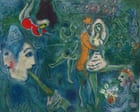
Hepworth Wakefield, West Yorkshire He spent over 60 years painting clowns, ringmasters and acrobats – and the results transport you to a dazzling magical world
At the opening of The Circus, a self-portrait of Marc Chagall is placed next to a lithograph of a clown. The portrait is small and sketched simply in a blue crayon, as if Chagall had quickly dashed it out to pacify an inquisitive fan. In contrast, the clown is rich in colour and texture, with a heavily detailed backdrop of musicians, spectators and performers. But there is something uncanny about this pairing, created more than 40 years apart. They both wear small, brimmed hats with hair springing out from underneath, and their facial expressions are somewhat inscrutable.
It is the perfect introduction to an exhibition that explores Chagall’s lifelong fascination with the circus, both as a subject and as a symbolic motif. In placing Chagall and the clown side by side, we understand this immediately – the clown is both a clown and a metaphor for the artist. In his 1967 art book Cirque, Chagall writes: “This clown – he is he and I.”
Featuring more than 50 works, The Circus is a dazzling exploration of one of the 20th century’s most distinctive artists, delving into the way this magical arena and its cast of intriguing characters captured Chagall’s imagination, dancing across his canvases for more than 60 years. For Chagall, the circus is a mesmerising space beyond reality where it is possible to find childhood memories, artistic inspiration, spiritual enlightenment and both radiant light and deepest darkness.
The show includes his theatrical collaborations, paintings he produced in a box at the Cirque d’Hiver, pieces he made after his return to Paris after the second world war, and autobiographical works relating to Vitebsk, Russia, where he grew up. But shimmering at the heart of this exhibition is Cirque, an art book, large suite of lithographs and essay (newly translated into English for The Circus).
An entire, windowless space in a deep red is the setting for Cirque, which is presented here in its entirety. With the colourful lithographs popping off the walls, it feels as though I have disappeared into a big top. This is enhanced further by the decision to record Chagall’s Cirque essay, which is read by a French actor to give the language the artist’s accent. I pop on the headphones and for 24 minutes I am no longer in misty Wakefield but in the rafters of a tent watching hoops spin – or centre stage beside a ferocious lion.
The language in Cirque is as important as the visuals; as with Chagall’s art, where bodies float and animals shapeshift, so the text moves from a memory of street performers in Vitebsk, to the tail of a circus horse, to the story of Noah, to the greed of humanity. While I listen, I observe the vivid, swirling colours of a red leotard, a clown’s painted face and a bouquet of flowers. In many of the lithographs reality melts away – a moon bursts through the big top, a fish plays a drum, a Janus-faced figure plays music and weeps at the same time. For all their sparkling joy, each work features a looming audience, their round faces in rows, indistinguishable but heavily present, judging and reminding us of the outside world. Chagall’s words play through the headphones: “Alas, in life I have seen a ridiculous circus: someone thundered to terrify the world, and a thunder of applause answered him.” The circus is not all fun and games, on either side of the canvas.
The clever thing about placing Cirque at the start of the show is that it is then possible to follow these motifs through the rest of Chagall’s work, both before and after Cirque’s creation. The Four Heads – one of 19 paintings Chagall created from a box at the Cirque d’Hiver – was made in 1927 and, featuring a clown atop a many-headed creature, captures an early interest in the momentary spectacle of circus. Much later pieces from 1980 of his home in Vitebsk also include acrobats, lovers dancing and instrumentalists, indicating that these performing artists had inhabited his mind since childhood.
It is clear that for Chagall, performance and circus are inseparable. His work for Mozart’s The Magic Flute at the Metropolitan Opera in New York in 1967 involved set and costume design. The archival design pieces presented here again find flying figures, animals and instrumentalists – and that oppressive audience, sitting just beyond the performance, passing judgment on the art.
The challenge for any curator is to create a space that does justice to the spirit of the art on display. This is particularly hard when the subject is a supernatural display of magic, movement and artistry. But The Circus more than rises to the challenge, with thoughtful interventions that elevate the entire experience. From the ceiling fall two large, patchwork curtains by German artist Ulla von Brandenburg, which are pinned back with rope as if we are entering a circus tent and everyday life can surrender to the wonder of performance. In the centre of the gallery, a small inner room plays archive footage from the Cirque d’Hiver, encapsulating the stunning skills of the performers in real life.
Early on in his Cirque writing, Chagall asks: “These clowns, these bareback riders, these acrobats have taken up residence in my visions. Why?” We will never know the full answer, but certainly they imbued his art with the sensation that the world may be more than it first appears, and that can be a glorious thing.
At the Hepworth Wakefield, West Yorkshire, 21 November to 25 April