 ewsba.se
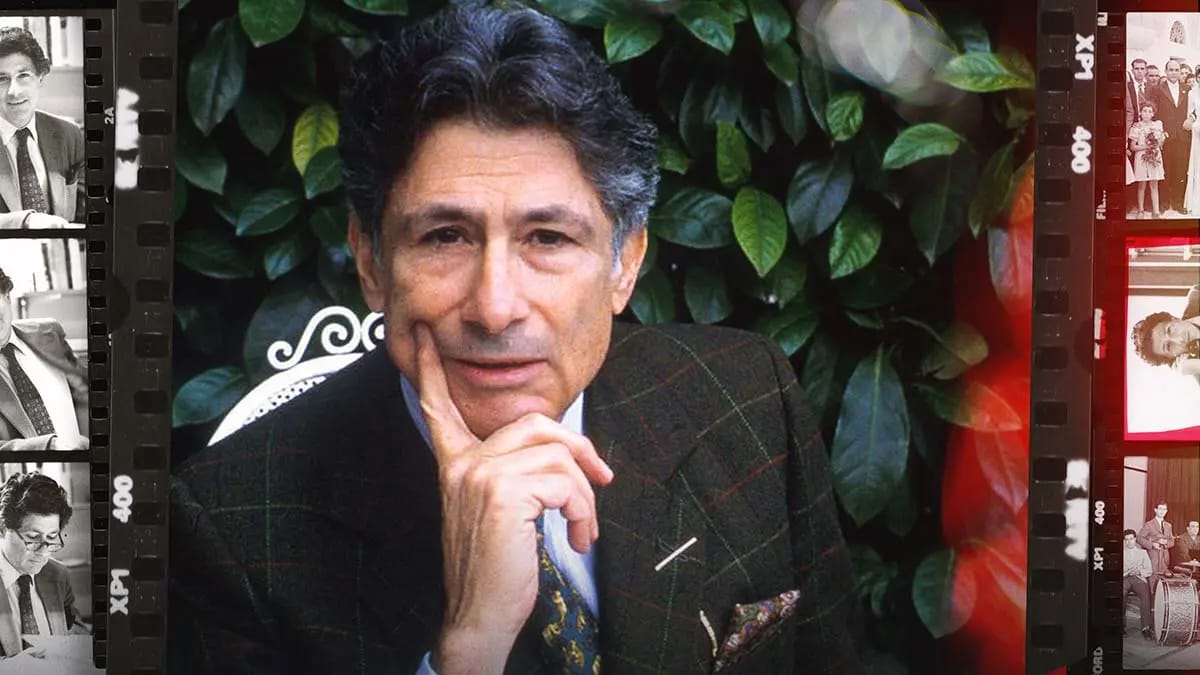
As a new documentary shows, the Palestinian scholar believed an intellectual must always oppose domination while cultivating resistance.
In their (still brilliant) 1990 experimental film Introduction to the End of an Argument, filmmakers Jayce Salloum and Elia Suleiman splice together troves of found footage about Palestinians and Israelis. The result is an exquisite mash-up of Hollywood cartoons and political clichés, a comic pastiche illustrating the common bond between Orientalism and zombies. Both just won’t die.
While Salloum and Suleiman’s film consists mostly of news clips and film reels, one of Gaza’s elder statesmen, the late Haider Abdul Shafi, does appear briefly twice. In one scene, Abdul Shafi, sitting at a nondescript table, is asked by an interviewer: “Is it your belief that if a Palestinian state was created, there would be lasting peace in the Middle East?” Just as he’s about to respond, the film mischievously cuts away, in an edit loaded with meaning. Palestinians may be seen in Western media, the film is telling us, but they cannot be heard from.
Maiken Baird’s new documentary, Edward Said: Between Worlds (2026), joyfully demonstrates how Edward Said was the exception to this semi-official ban on Palestinians representing themselves. Like Salloum and Suleiman, Baird also sifts through reservoirs of found footage, though the result couldn’t be more different. Offering a rough chronology of Said’s life, Baird’s film celebrates him by highlighting his contributions and lasting influence in numerous domains, from literary theory to American foreign policy.
For decades, the Columbia University professor of comparative literature was the most famous, if not the only, Palestinian regularly speaking on American airwaves and writing about the Palestinians in its magazines. Wearing his bespoke suits and contributing classical music criticism to the Nation, Said cut an urbane, sophisticated, and cosmopolitan figure.
But it was his substance, and not his style, that earned him his legacy. As the author of the foundational text Orientalism, Said was one of the most influential intellectuals of the 20th century, and he took the vocation extremely seriously, holding the yes-men intellectuals of the powerful in contempt. As he wrote in his essay “Secular Criticism": “It is not practicing criticism to validate the status quo.” For Said, an intellectual must always oppose domination while cultivating resistance to oppression.
I am one of the fortunate ones. I knew Edward Said personally, having studied under him while I completed my PhD at Columbia University. With Andrew Rubin, another of his students, I edited The Selected Works of Edward Said: 1996-2006 (2019). (A producer of this film contacted me during its early phase for a background discussion on Said and his life, but I had nothing to do with the making of this documentary.) It’s hard to believe that more than 20 years have passed since Said died from leukemia in 2003, but thanks to Baird’s documentary, a new generation can now access his indomitable energy and inexhaustible fight for justice.
With the question of Palestine currently assuming a new urgency around the world, and with Israel’s genocide of Gazans ongoing, the timing of the film feels like a deliberate intervention. To recover Said’s voice is to rediscover some of the most compelling arguments that have been made for Palestinian liberation. It’s no mistake that, aside from hearing a few interviewers’ questions and small asides, the audio of this 108-minute film consists almost entirely of Said speaking.
Produced with the cooperation of the Said family, the film includes moments from early home movies taken by Wadie Said, Edward Said’s father. The elder Said purchased a movie camera in 1938 and made “incredibly boring” films, according to the younger. By including snippets of these early scenes, Baird does something more than show us a young and gangly Edward Said. The home movies not only invite viewers into the private life of a Palestinian family in Palestine. They also become an assertion of presence against an ideology which demands Palestinian absence.
Young Edward was entirely apolitical. As a teenager, he was expelled for being a “troublemaker” from Victoria College in Egypt and sent by his family to the “puritanical” Mount Hermon School in rural Massachusetts, where, as he says, he was mocked endlessly for his name (“Ed Said. Well, what did he say?”). An elite education at Princeton and Harvard followed, and then a job as an assistant professor at Columbia University. “The professional thing took care of itself,” he says. But after the humiliating Arab defeats of the 1967 war, Said felt a need to reconcile the two parts of himself: an American professor of literature and a Palestinian Arab born in Jerusalem. In the wake of the losses in 1967, his friend Ibrahim Abu-Lughod invited him to contribute an essay to the United States-based magazine The Arab World, and Said wrote “The Arab Portrayed,” his first significant foray into the politics of representation.
In the film, Said describes his decisions to take on the Palestinian cause, and his father’s caution to his son: “I’m very worried about what the Zionists will do to you." In the early 1970s, while living in Beirut, he immerses himself in the Arabic language and literature and associates with some of the preeminent Palestinian intellectuals of the era. The film’s tempo picks up as Said’s star begins to shine more brightly. We watch him being asked borderline racist questions in multiple TV interviews, see him with Palestine Liberation Organization (PLO) leader Yasser Arafat, and despair with him when the Israeli invasion of Lebanon leads to the expulsion of the PLO from Lebanon in 1982.
Said was the most prominent dissenting Palestinian voice to the 1993 Oslo Accords. He believed the PLO had sold out the Palestinian national movement, only to become “Israel’s enforcer” of the occupation. Baird’s film successfully shows how he went from being a fierce critic of American and Israeli policy to a fierce critic of American, Israeli, and Palestinian leadership. I knew Said at this time in his life, and what the film doesn’t show is the profound sense of isolation he felt while the entire global liberal establishment was telling us that “the conflict,” as it’s euphemistically called, was about to be solved. Needless to say, Said was right.
Music was a grounding force in Said’s life (he was a near-concert-level pianist) and another constant in the film. Baird ends her film with his growing friendship with the Argentinian-Israeli composer Daniel Barenboim. Said and Barenboim began the West-Eastern Divan Orchestra, a musical venture bringing together young Arab and Israeli musicians, in 1999, the same year his essay “The One-State Solution” was published in the New York Times. The essay argued that “real peace can come only with a binational Israeli-Palestinian state.”
In the final years of his life, Said committed himself to such efforts at coexistence. The last scene of this finely tuned documentary is of him playing the piano with passionate intensity. “It’s not our destiny to be refugees," he says via voiceover. "It’s not our destiny to be prisoners of war. It’s not our destiny to be commandos. It’s not our destiny to be an army of occupation. We have a choice.”
There is more than a whiff of optimism in these later positions, and it’s impossible to say where Said would stand today, as Palestinians face their most demanding fight for survival yet. But the fact that his optimism feels somewhat dated today probably tells us less about Said and more about how far away we are now from attaining true and lasting justice for the Palestinians.
Edward Said: Between Worlds (2026), directed by Maiken Baird, is screening at various film festivals including the International Documentary Film Festival Amsterdam, London Palestine Film Festival, Marrakech International Film Festival, and many more. It will be released widely in 2027 by Kino Lorber.