 ewsba.se
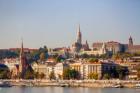
In April, Hungarians shook off 16 years of right-wing populist rule when they voted overwhelmingly against prime minister Victor Orbán and his Fidesz party. With Orbán’s culturally regressive movement in tatters, Budapest is now reclaiming its status as one of Europe’s most important artistic capitals, and experiencing a wave of visitors newly drawn to the city in the wake of the country’s political about-face.
Hungarians trace their history back to around 900 AD, when nomadic Magyar tribes arrived in Europe’s Carpathian basin, but their capital city and their national identity are really 19th century inventions. The sprawling, multi-ethnic Kingdom of Hungary, which once stretched from the Mediterranean to what is now southwestern Ukraine, rebelled against Hapsburg dominance in the mid-19th century. That break culminated in 1866, when Austria and Hungary became constituent parts of a new dual monarchy, spurring on the 1873 union of the separate towns of Buda and Pest, reconstituted as a Belle-Époque boomtown.
Hungary’s best-known art institution, the Museum of Fine Arts, Budapest (MFAB), first opened in 1906 on the Pest side of the Danube, though it has roots in an earlier collecting spree of the Esterházy family, the highest of Hungary’s high nobility. The museum’s broad range of Old Master paintings and its world-class prints and drawings collection arguably make it the most important museum of its kind between Vienna and St. Petersburg. In 1957, the bulk of its Hungarian holdings were separated into a new institution, the Hungarian National Gallery, which eventually moved over to the Buda side of the city, into the onetime Habsburg Royal Palace. Though the Orbán regime had planned to rehouse it again, it remains in situ for the time being, and its collections of Hungarian art, spanning centuries, testifies to a rich and varied artistic tradition almost entirely unknown outside the country. Back over in Pest, a new cultural development, Müpa Budapest, opened in 2005, providing a home to the city’s Ludwig Museum, with a collection of contemporary art from national and international figures.
Raphael's Esterházy Madonna (around 1508)
© Szépművészeti Múzeum/ Museum of Fine Arts, Budapest
Raphael's Esterházy Madonna (around 1508)Museum of Fine Arts, BudapestHeroes’ SquareTiny and technically unfinished, with the Virgin’s face and the figures of the Christ child and St. John the Baptist mere underdrawings, this tempera-and-oil on panel work has a grace and graphic quality that have helped make it the best-known Renaissance work in the country.
Produced at the end of Raphael’s Florentine period, when his output still reflects a youthful interest in Leonard da Vinci, the painting apparently first made its way north of the Alps in the early 18th century during the papacy of Clement XI, landing in the Esterházy collection by 1812. Stolen in 1983, along with the museum’s prized Giorgione portrait and other works, it was recovered the following year in a Greek monastery.
Mihály Munkácsy's The Last Day of Condemned Man (1870)
Credit: Museum of Fine Arts Budapest – Hungarian National Gallery
Mihály Munkácsy's The Last Day of Condemned Man (1870)Hungarian National GallerySzent György térIn Hungary’s heyday before the First World War, when Budapest began to compete with Vienna, painter Mihály Munkácsy was a national hero. Born in what is now Ukraine, then educated at the art academies of Vienna, Munich and Düsseldorf, he eventually settled in Paris, with a base of collectors stretching from Central Europe to the American Midwest. His Budapest funeral procession, in spring 1900, was witnessed by hundreds of thousands people and remains a unique event in the history of the country.
Working in a number of established genres, from history painting to portraiture, he went on to decorate both Vienna’s Kunsthistorisches Museum and Budapest’s new Parliament building. But this breakthrough work—which scarcely gives a clue whether the condemned man in question is a criminal or a victim of injustice—remains his best known. Winning a gold medal at the 1870 Paris Salon, it was a main topic of conversation in the French capital during the final days of the doomed Second Empire.
Leonardo da Vinci's Study for the Head of a Soldier in the Battle of Anghiari (around 1504–05)
Museum of Fine Arts, BudapestHeroes’ SquareThe MFAB's prints and drawings collection has legendary status among scholars in the field, with key works stretching from Renaissance Italy to early 20th-century Vienna, leading up to the present day. This exquisite Leonardo drawing—one of three in the collection—is a preparatory work associated with a planned mural in Florence’s Palazzo Vecchio meant to commemorate the Florentine Republic’s victory over the Duchy of Milan in 1440.
Left unfinished in 1506, when Leonardo himself left for Milan, the partial mural, made using an unstable oil-based technique, was nonetheless one of Cinquecento Florence’s star attractions, until its degraded version fell victim to a 1560s renovation. This red-chalk drawing of a Florentine captain, produced using a live model, is known for its depiction of intense emotion.
Hungarian crown jewels on display in the parliament building
The Holy Crown of Hungary (around 12th century)Hungarian ParliamentKossuth Lajos térThe Kingdom of Hungary—defeated in the First World War, then dismantled, degraded and now disappeared—lives on in this mysterious and glorious object. One of Europe’s oldest surviving crowns, with a lower section of enamel imagery dating all the way back to medieval Byzantium, it likely took on its present appearance in the 12th century. Containing both Latin and Greek inscriptions, and bejeweled with sapphires, garnets and amethysts, the elaborate golden crown had mystical status. It was not only a symbol, but treated as the actual incarnation of the Hungarian state, and sovereigns were not regarded as rulers until it was placed on their heads.
A miraculous survivor of Hungary’s cataclysmic 20th century, it was brought back into use in 1990 following the collapse of communism. Placed on Hungary’s newly devised coat of arms, it has been on display in the national parliament since 2000.
Lili Ország’s Wall of Icons II (Blue) (1969)
Hungarian National GallerySzent György térNow regarded as one of the most important artists to emerge in Hungary after the Second World War, Ország, born into a Hungarian Jewish family in what is now Ukraine, barely escaped being deported to Auschwitz and later survived the war as a Christian convert.
Judaism, Christianity, and her own biography fuse together in her mature paintings, whose religious elements were in defiance of official communist policies. This late piece, showing a repeating Madonna-and-Child motif, is part of a series of oil-on-fiberboard works. Invoking her longstanding interest in Orthodox Christian imagery, it also alludes to her own trauma at not having had a child.
Francisco de Goya’s The Water Carrier (1808 – 12)
Museum of Fine Arts, BudapestHeroes’ SquareGoya’s transition from a designer of Rococo tapestries to the great harbinger of Modernism is on view in this legendary painting, made during the dark years of Napoleonic Spain's Peninsular War, a guerrilla conflict that foreshadowed the atrocities of the 20th century.
An apparent genre scene showing a rustic girl carrying food and water, the painting is in fact a wartime vision of desperate heroism. The late art critic Robert Hughes was fascinated by the work, which he regarded as an “emblem of resistance.” He writes, in his 2003 biography of the artist: “You would be very grateful to see her if you were crouched stiffly behind a rock in the parching autumn sun of Aragón, breathing hot dust with the ricochets whining above.”
Can Togay and Gyula Pauer’s Shoes on the Danube Bank (2005)Id. Antall József rkpIn the years after the collapse of communism in 1989, the newly open societies of Central and Eastern Europe revisited the horrors of their 20th century in a number of commemorative works. This installation on the banks of the Danube, which memorialises the victims of the predominantly anti-Semitic massacres by Hungary’s fascist militias in 1944-45, is now considered one of the most artistically successful.
Comprising 60 pairs of rusty iron shoes, it was devised by Togay, a filmmaker, and executed together with Pauer, a performance artist and sculptor. Fixed in concrete but eerily scattered, the shoes—in women’s, men’s, and children’s sizes and styles—recall the militia's orders of its victims to remove their shoes before shooting them into the river.
© Museum of Fine Arts – Vasarely Museum, Budapest
Victor Vasarely's Zebras (1939)Vasarely Museum BudapestSzentlélek térFor the first few decades of the 20th century, Budapest was a hothouse of the avant-garde, nurturing the likes of Modernist painter László Moholy-Nagy; Bauhaus architect Marcel Breuer; and the supreme chronicler of 1930s Paris, photographer Gyula Halász, otherwise known as Brassaï. Their work is hard to find back in Budapest, but their near contemporary, Victor Vasarely, the great pioneer of Op Art, has his own museum here.
Schooled in Modernist trends in a Budapest private art academy, Vasarely decamped for Paris in 1930, and his experiments there in the late 1930s anticipated Op Art’s illusions and manipulations by some three decades. This tempera-on-paper work was a stand-out at this year's survey of the artist, Vasarely 120, held at MFAB. It is considered a great forerunner of the movement, which Vasarely went on to promote, often in ever-larger formats, until his death in 1997, aged 90.
Pieter Bruegel the Elder's The Preaching of St. John the Baptist (1566)
Museum of Fine Arts, BudapestHeroes’ Square
Hungary’s longtime Habsburg rulers, residing up the Danube in Vienna, began amassing their unique collection of works by Pieter Bruegel the Elder within decades of his death in 1569. But this late work somehow got past them, ending up in the Hungarian collection of the noble Batthyány family.
A vast social panorama, with a solemnity largely missing from the artist’s more raucous works, the painting depicts nobles and soldiers, burghers and peasants, Jews and Turks, the healthy and the infirm. Nearly all are transfixed and transformed by the teachings of Christ, as spoken by St. John the Baptist, who is illuminated by little more than the attention of the crowd.
Dóra Maurer's Bent Plane with Wings (1996)
Photo © József Rosta / Ludwig Museum - MoCA, Budapest
Dóra Maurer's Bent Plane with Wings (1996)Ludwig MuseumKomor Marcell utcaDuring the Orbán years, Budapest’s large national art institutions took on a retrograde atmosphere, with leading artists, like their emerging counterparts, often resorting to alternative or municipal venues. Paradoxically, it coincided with an international breakthrough of some cutting-edge figures, like Maurer, who had a 2019 survey at London’s Tate Modern.
A trained graphic artist, Maurer was eventually drawn to geometric abstraction and witty illusionism. This mature acrylic-on-wood piece, acquired by the Ludwig Museum in 1998, uses lines on an apparently curved surface to create a near-sculptural, if resolutely two-dimensional piece.