 ewsba.se
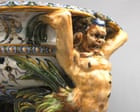
Wallace Collection, London A sword, a wine cooler, a dazzling fresco … only a museum with such a copious store of treasures could put on a display this rich without having to borrow
Mounting a “store-cupboard” exhibition – choosing items from existing collections to make a new, contained display – can be a cheap and easy way for a museum to make something out of its existing resources, without the faff of securing loans or collaborating across the industry. In the case of the Wallace Collection, however, the store cupboard is so embarrassingly rich and diverse that strong displays such as this on Cosimo I de’Medici can be drawn from only a handful of its objects.
The 19th-century collection of Sir Richard Wallace holds a notable number of medieval objects, but their display can seem – at least to contemporary eyes – like a cacophony of applied arts, armour and paintings, not to mention a ton of gilt. This Medici display is part of a new enterprise drawing out histories from the noise for singular focus, sensibly repurposing what was once the cloakroom (a previously wasted bit of prime real estate) as a new dedicated space.
The Medici family history itself is more labyrinthine than can be captured in a single exhibition, even for diehard historians (or, I dare say, bingers of the 2016 Italian-British TV series), and the Wallace eschews dense background reading here. It has a dual obligation to impart the artwork’s historical significance in relation to its existence in the Wallace Collection, which is perhaps why it omits significant details regarding Cosimo’s role in founding the Uffizi Gallery and expanding the Pitti Palace in Florence. We get the key grounding, however, in that in 1537, the 17-year-old Cosimo was elected as the new duke of Florence. This followed swiftly after the assassination of the last male heir of the senior branch of the Medici family, Alessandro, leaving a power vacuum at threat from republicanism.
And, crucially, it demonstrates that it is not necessarily the most “beautiful” works that are the most compelling. It’s always secretly thrilling to encounter a fresco that’s been hacked off the wall (removal videos are nail-biting stuff), and a 1464 fresco of the young Cicero reading taken from a Milanese branch of the Medici bank even has chunks at its base missing, the snap-lines used to mark out its design in wet plaster clearly visible up close in raking light, and somewhat hilariously mounted in an incongruous wooden frame. Among its usual Wallace location the clunky fresco medium would usually pale next to its fine art neighbours – now it shines in the spotlight.
We are told how the statesman Cicero was a model of civic virtue and morality and hence adopted as a symbol of the Florentine republic. He is envisaged here (in a commission by Cosimo the Elder, not Cosimo I as is the case for every other piece – pay attention at the back!) as a studious young figure with a sense of industry and success, implying similar connotations for the benefacting Medici family.
The varying amount of iconographic content – ie, the visual symbolism deliberately used by Cosimo I for dynastic purposes – does highlight the limitations of working within Wallace’s collection. Certainly, a parade helmet (c1550) and sword (1546-69) bear a plethora of imagery and were inventoried in the Medici armouries as alluding to Hercules, who was commonly said (by Florentines) to have founded Florence. Cosimo’s heraldry sits next to an Order of the Golden Fleece, of which Cosimo was a member, and topped by a ducal crown, despite his only becoming grand duke in 1569. In short, the iconographic picture and dynastic assertion is bright and clear.
Yet the show’s (literal) centrepiece, a 1574 earthenware wine cooler, bears only Cosimo’s personal emblem, a turtle with a sail, alluding to the motto festina lente (make haste slowly), which was itself pinched from Roman emperor Augustus. The rest of the glazed iconography is a combination of fanciful mythological whimsy, satyrs and monstrous figures. It bears a naval battle which it is noted can only with certainty be linked to its purpose for holding liquid. Unlike the armour for which its display purpose – and audience – was obvious, we can only speculate on the audience for such an object other than banqueting and revelry. Perhaps we can – only half-jokingly – look to the glaringly formidable testes of the carved monsters supporting the bowl for further declaration of dynastic strength and rigour.
Such a sparse but precise display is welcome as a contrast with the Wallace’s visual overwhelm, using close and precise old-school art historical analysis to draw out one strand of its many contained histories. Even the choice of terracotta wall colour instantly imparts a Florentine flavour – a smart touch. Its limitations remind us that the collection is based on personal, not curatorial choice, : we don’t even have a portrait of Cosimo himself in the collection, despite Bronzino having churned out dozens of them. Yet hopefully there will be more studies like this to enjoy.
At the Wallace Collection, London, until 21 March