 ewsba.se
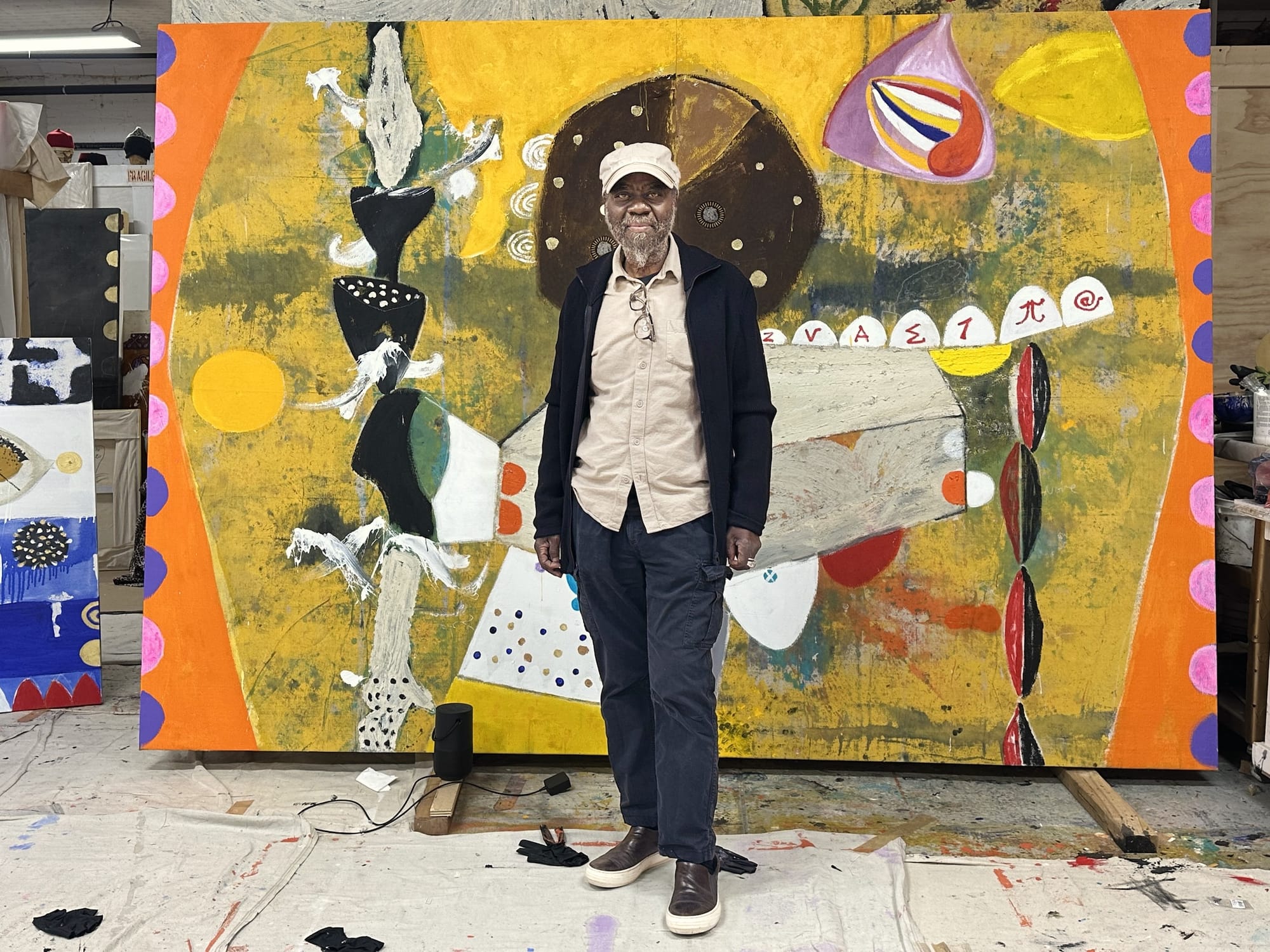
The Ivorian-born painter works only at night, when the veil with the spiritual realm is thinnest and the outside voices of the physical world are quietest.
Last month, just a couple of weeks before Ouattara Watts’s solo show opened at Karma, I was directed to knock on the cracked glass door of his Bushwick studio. We met in the late afternoon, which is when his studio time begins. The Ivorian-American artist has coffee and a light evening meal, and works all night, before returning home to sleep during the day. To learn why Watts works only at night, one need only look at his paintings. He views art as a portal to the divine; night is when the veil with the spiritual realm is thinnest, and the outside voices of the physical world are quietest.
Although a gallery representative had told me Watts would be putting “finishing touches” on the paintings for his exhibition at the time of our meeting, I came to realize that he thinks about the work, and his process, without a beginning or end. The centrifugal energy of his rhythmic compositions does not obey edges. Totemic forms continue beyond the bounds of the canvases; arrows point in varying directions; seed pods are split open to reveal concentric circles. His compositions are stained and dripped fields populated by a lexicon of imagery and symbols, developed over the past four decades. They include coffee beans, sacred books, musical notes, serpents, bursting petals encased in atoms, diagrammatic cubes, and mathematical codes.