 ewsba.se
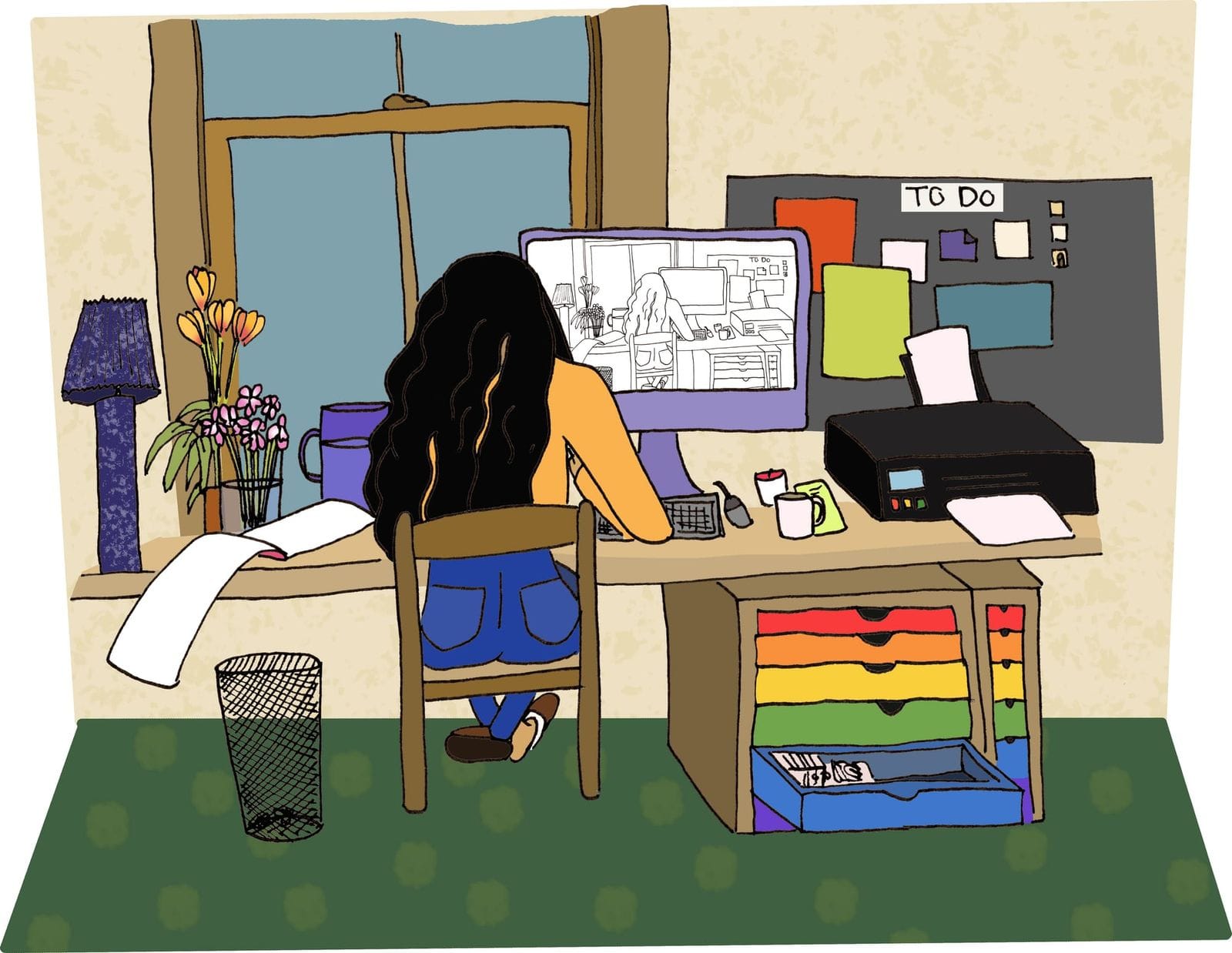
The award-winning journalist and artist talks about her first book. Plus, Carolina A. Miranda on two new Guadalupe Rosales tomes out this fall.
Mona Chalabi is a Pulitzer Prize-winning journalist, and as much as it shows across her incredible body of visual data reporting, she has always kept her eye on another prize entirely. I sat down with her earlier this fall at Christopher Park across from the Stonewall Inn, a site of protest and resistance, to talk about her new book and her career as a whole.
The culmination of six years of research, interviews, and illustration, Ten Lives breaks the silence around class in her characteristic visual style. To me, it’s a reflection of her principled approach to journalism and storytelling that feel utterly lost in a world where self-promotion, access, and branding can matter more than the work itself. Chalabi brings a refreshing integrity and playful approach to reporting unflinchingly on the genocide in Palestine, the horrors of the healthcare system, and massive wealth inequality. While she insists her work isn’t “fine art,” it’s perhaps the purest example of what art should do: challenge our ways of seeing. She’s also uncommonly funny, humble, and perceptive. (Can you tell I’m a fan?)
Class is also at the center of photographer Mark Alice Durant’s memoiristic book, which critic Melissa Holbrook Pierson likens to Rainer Maria Rilke’s Letters to a Young Poet for our dystopian world of 2026. Other books in this edition similarly respond to the Orwellian state of art and power. Nitasha Dhillon and Amin Husain, both scholars and activists, have organized protests against the Museum of Modern Art in 2021, the Whitney Biennial in 2019, and the Guggenheim Abu Dhabi in 2015, among other instances of artwashing. They penned a joint review of Italian curator and organizer Marco Baravalle’s book The Battleground of Art: Radical Curating in the Crisis of Neoliberalism, a toolkit for seeing through the mainstream art world’s undermining of political movements and building sustainable alternatives.
Critic Carolina A. Miranda, meanwhile, takes up two new books by East Los Angeles artist Guadalupe Rosales, who came up in a community of Chicano kids raised in the 1990s amid uprisings and political action. Miranda writes that the anthology Rosales edited, as well as her blended memoir and photo book, perfectly encapsulate “the ways she engages the stories of others even as she tells her own.” A wise observation to carry with us as we face the week ahead; more of the latest in art book reviews and news below.
—Lakshmi Rivera Amin, associate editor, books
“The crisis is the system that we’re in,” the Pulitzer Prize-winning data journalist and artist says in an interview with Hyperallergic about her first book, “Ten Lives.” | Lakshmi Rivera Amin
Fall 2026 Art and Architecture Books from Yale University PressThe Bayeux tapestry, a new biography of Edward Hopper, The Met’s exhibition catalogue on Krasner and Pollock, what architecture is, and more
Author Catherine Ostler follows the lives of the two cherubic girls, whose rarefied lives in an elite, artistic French family would be toppled by the horrors of the Holocaust. | Eurídice Arratia
In “The Battleground of Art,” curator and activist Marco Baravalle dissects the art establishment’s co-optation of radical politics and uplifts the stories of collectives that resist it. | Nitasha Dhillon and Amin Husain
In two new books, the artist weaves her archive of photos, ephemera, and flyers into the story of ’90s Chicanx youth culture, tracing both a personal and collective coming-of-age. | Carolina A. Miranda
In his memoiristic new book, photographer Mark Alice Durant weaves his personal experiences into a larger rebuke of the economic inequality that governs the art world. | Melissa Holbrook Pierson
From art history to instruction, Quarto publishes visually-rich books for artists of all mediums and skill levels.
A review of an ancient Chinese ink painting takes an art critic on a journey through his own past. | Will Heinrich
Lakshmi Rivera Amin, associate editor, booksAs I rejoin the queue for the Valeria Luiselli book that expired on my Kindle — the Brooklyn Public Library doesn’t play about digital loans — I’ve added a romance novel to my rotation: Ali Hazelwood’s The Love Hypothesis (2021). It’s predictable, it’s corny, and it’s just STEM enough to make me feel like I’m learning something about scientific research funding and early-detection cancer biomarkers. Truly the perfect holiday-season read.
Rebecca Schiffman, associate editorI just got a copy of Min Jin Lee’s highly anticipated American Hagwon and 50 pages in, I’m already hooked. The third in her Diaspora Quartet, it follows a Korean family doing their best to assimilate and find their place at a hagwon, or cram school.
Stéphane Breitwieser stole several billion dollars worth of art from more than 150 museums before he was caught in 2001. | Erin L. Thompson