 ewsba.se
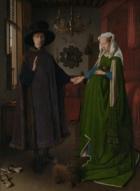
Reality check: the identity of the couple in The Arnolfini Portrait (1434) by Jan van Eyck is not the only contested element in the painting—the woman’s pregnancy, the event and the actuality of the room are also hotly disputed The National Gallery, London
Jan van Eyck’s Arnolfini Portrait (1434) has been a signature work in London’s National Gallery since it arrived at the museum in 1842. A few key facts about the dual portrait, showing a youngish man and his idealised wife, could be gleaned just by looking at the work’s prominent Latin inscription, which translates as “Jan van Eyck was here 1434”. Over the years, just about everything else associated with the painting, from its mysterious room to the obscure occasion, has been open to debate, other than the surname of the man—Arnolfini, connected to an extended family of wealthy merchants from Lucca active in 15th-century Bruges, where Van Eyck had his studio.
Now, on the occasion of the National Gallery’s exhibition Van Eyck: The Portraits (21 November-11 April 2027), which brings together all nine of the artist’s surviving panel portraits, the Berlin-based curator Stephan Kemperdick, writing in a catalogue essay, has planted a possible bombshell by suggesting that the man in the Arnolfini Portrait is Van Eyck himself, and that the woman standing next to him is the artist’s wife Margaret, the sitter in another Van Eyck portrait from 1439, which is on loan to the show from Bruges.
Kemperdick’s theory, presented in recent talks but published now for the first time, is not an entirely new one. In the late 1840s, the National Gallery’s future first director Charles Eastlake contended that the artist’s inscription, which he thought could be translated as “Jan van Eyck was this [one]”, meant that the painting was also a dual portrait of the artist and his wife. But in the early 1860s, the British art historian W. H. James Weale interpreted a reference in a 16th-century inventory to a certain “hernoul le fin” in the painting, which he regarded as the French version of the Italian surname Arnolfini. The connection between the couple and that family was thus set in stone, though scholars disagree, often vehemently, about which particular member of the Arnolfini clan is shown.
Kemperdick has revisited the inscription, which is unusually large and conspicuously places the artist’s name next to the male figure’s head. He argues this indicates a direct connection between Van Eyck and the man. He has also reconsidered the association between the “hernoul le fin” reference and the surname Arnolfini. Citing the early-modern categorisation of the late-medieval work as not a portrait at all, but rather a lewd genre painting, Kemperdick suggests that “hernoul le fin” is not the correct surname of the sitter, but a subsequent and mocking moniker used by later generations to misidentify the man as a “a deceived cheat”. Kemperdick also suggests that a reference to St Margaret in the bedstead statue near the woman’s head serves to identify her as Van Eyck’s wife.
Kemperdick is the curator of German, Netherlandish and French Paintings before 1600 at the Berlin Gemäldegalerie, which is noted for its Early Netherlandish holdings and has in its own collection a Van Eyck portrait (around 1435-38) of the very same man who appears in the National Gallery’s Arnolfini Portrait. The two will be shown together in the London exhibition.
Nicholas Flory, the co-curator of Van Eyck: The Portraits along with Emma Capron, the National Gallery’s curator of early Netherlandish and German painting, says that he and Capron find Kemperdick’s theory “interesting” but “speculative”, citing, among other reasons, that the woman in the Bruges portrait, whom we know to be Margaret based on the inscription, has greyish-blue eyes while the woman in the Arnolfini Portrait has brown eyes.
Other leading Van Eyck scholars also have their doubts. The German art historian Till-Holger Borchert—now the director of the Suermondt-Ludwig-Museum in Aachen and the former director of Musea Brugge in Bruges—is familiar with Kemperdick’s theory. “I’m not entirely sure I can concur,” he says. He thinks the early-16th-century inventory reference—associated with the painting’s owner at the time, Margaret of Austria, the governor of the Habsburg Netherlands—is a near iron-clad reference to the Arnolfinis. The Ghent University art historian Maximiliaan Martens, who has been involved in the lengthy restoration of Van Eyck’s Ghent Altarpiece, also “doesn’t see any reason to doubt” that the inventory reference is to the Arnolfinis.
The implications of Kemperdick’s theory are far-reaching. Another Van Eyck portrait at the National Gallery, from 1433, showing a much older man than the figure in the Arnolfini Portrait, is now tentatively identified by the London museum as a self-portrait. This, however, cannot be the case if Kemperdick’s theory is correct.
The exhibition Van Eyck: The Portraits will label the Berlin work with its previous and longstanding reference to the Arnolfinis, while the Gemäldegalerie, under Kemperick’s guidance, has recently renamed it Portrait of a Man with a Red Chaperon. And the debate about the couple promises to continue long after the show closes in April.
“I have thought for 30 years about this,” Martens says of the figures in the Arnolfini Portrait. He says he is still not sure if the man is Giovanni di Arrigo Arnolfini (who was apparently not married at the time the painting was made) or his cousin, Giovanni di Nicolao Arnolfini (whose wife had died before the painting was made).
Other aspects of the dual portrait that scholars continue to debate include whether the heavy-bellied woman is actually pregnant (Kemperdick and Martens think that may be possible, while Flory and Capron think she is just gathering up her heavy skirts), and whether the room itself is a real space or an imagined one (imagined, say Flory and Capron; real, says Martens).
Beyond who made it and when, the Arnolfini Portrait remains a mystery, which is in keeping for an artist whose date and place of birth, among other foundational knowledge, is also speculation. Asked to comment on the enigma associated with the Arnolfini Portrait, Borchert says: “Can you tell me anything about Van Eyck that isn’t enigmatic?”