 ewsba.se
Mona Chalabi, Anne Anlin Cheng and Patty Chang, Miles Greenberg, Betsy James Wyeth, and the hottest memes about the Nvidia honeypot.
Framed by their car’s windshield, and then again by my rearview mirror, a man and a woman who seem to be a couple look like they'd rather be anywhere but together. He’s behind the wheel, doing all the talking; she’s looking straight ahead, motionless like a marble statue. Gradually, her face wears a desperate expression that only grows more hopeless as he continues talking and gesticulating.
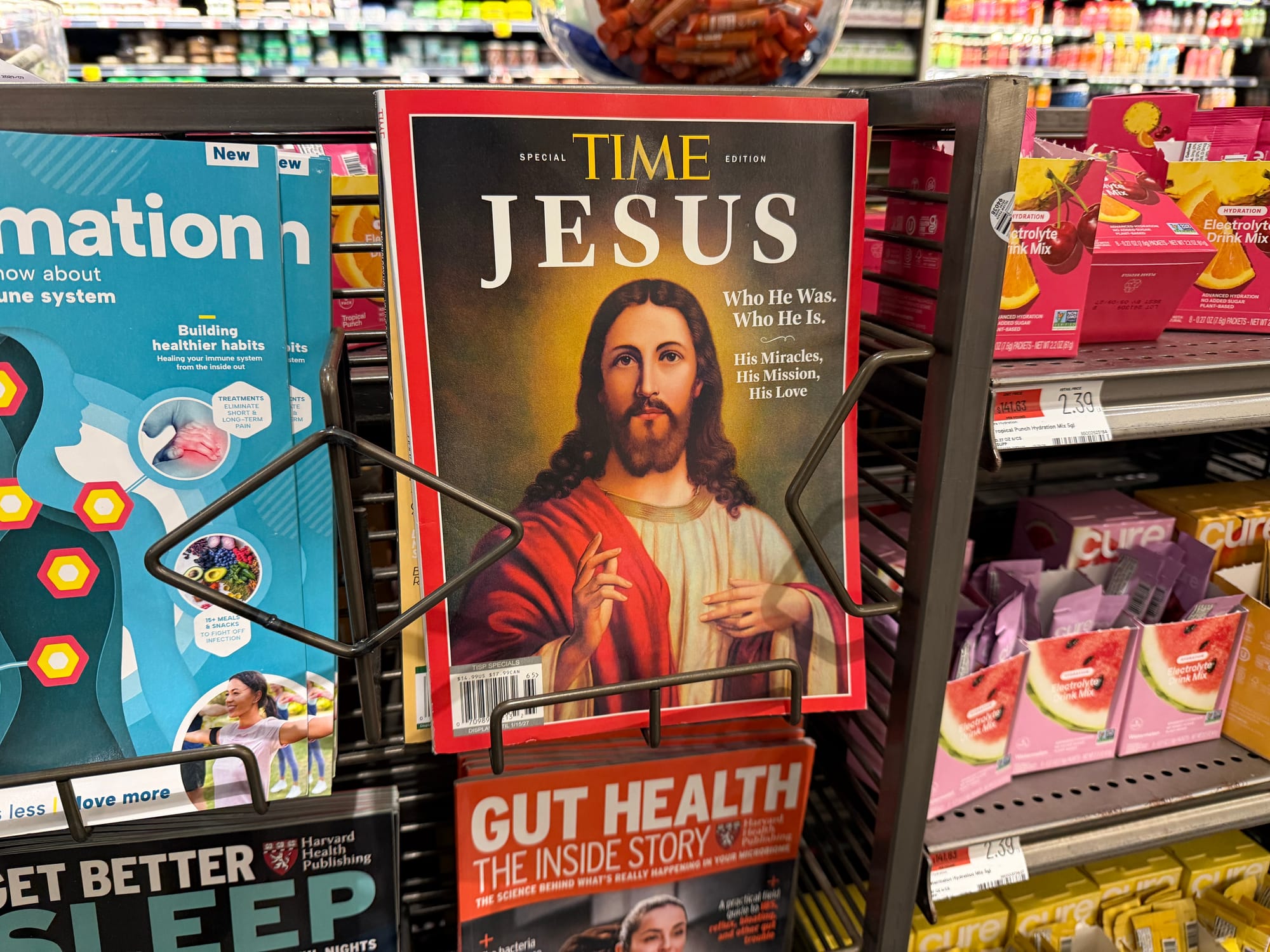
In the supermarket checkout line, I pick up a copy of TIME magazine for the first time in God knows how long, drawn to a painting of Jesus Christ on the cover. It’s a special edition promising to tell us “Who he was. Who he is. His miracles, his mission, his love.” I expect to see a lot of biblical sheep inside, but I don’t find any. I buy the issue as an artifact. I stopped believing in TIME magazine a long time ago.
Down the street, a place that pretended to be a legitimate art gallery for a couple of months, showing the worst possible commercial art, has finally given up, and now it’s selling fur coats. A man in a cowboy hat walks past two girls dancing for a social media video. The air is chilly, and I think of buying myself a leather jacket.
She looks at me with the most loving eyes as she holds a stack of perfectly folded laundry. She comforts me with her wide, auspicious smile, her jet-black hair, and her wrinkle-free, porcelain skin. I feel safe, accepted, and not judged. “Fast service, same day,” she promises because she’s just a model in an ad for a laundromat.
“As an adult and as a journalist, I have stared shamelessly.” That refusal to look away is precisely what data journalist, writer, and artist Mona Chalabi has built her deeply principled career on. Known best for her indelible data visualizations, from the obscenity of Jeff Bezos’s wealth to the Israeli government’s starvation of Palestinians in Gaza and the racial and gender biases in museum collections, the Pulitzer Prize-winning Iraqi-British journalist tackles the subject of wealth and economic inequality in America in her first book, Ten Lives: How What We Have Shapes Who We Are (2026). | Lakshmi Rivera Amin
Study Contemporary Art at Sotheby's Institute
Whether you’re pursuing a degree, developing your professional expertise, or deepening your knowledge of contemporary art, discover opportunities to learn from specialists and engage directly with the international art world.
The internet is having a field day after the tech mogul confessed to having an affair with a suspected Chinese intelligence spy. | Anna Lee
From Willem de Kooning’s miserable nudes to Alexandra Barth’s hot and bothered architecture, sex is in the air in Chicago. | Lori Waxman
The Art Dealers Association of America’s chummy five-day show returns to the Upper East Side after quietly canceling last fall’s edition. | Aaron Short
A group of 50 used puppets and a fake arch to deliver the point that Americans are against the “Arc de Trump.” | Emma Cieslik
The private collection opened its Branchline location in Katonah as a way to bring Native art into public view, though questions linger about its engagement with the local Lenape community. | Petala Ironcloud
A wide-ranging book and exhibition reveal the ways the multi-hyphenate’s architectural-environmental projects shaped her husband Andrew Wyeth’s celebrated painting career. | Julie Schneider
“Insincere ironic detachment is abundant,” the Bay Area artist told Hyperallergic. “What is niche now are sincere depictions of the present.” | Max Blue
Author Catherine Ostler follows the lives of the two cherubic girls, whose rarefied lives in an elite, artistic French family would be toppled by the horrors of the Holocaust. | Eurídice Arratia
A review of an ancient Chinese ink painting takes an art critic on a journey through his own past. | Will Heinrich
In “The Battleground of Art,” curator and activist Marco Baravalle dissects the art establishment’s co-optation of radical politics and uplifts the stories of collectives that resist it. | Nitasha Dhillon and Amin Husain
The Met Museum’s “Chasing Clouds” is a pleasing romp through the technical problem of capturing clouds at photography’s beginning. | Julia Curl
The best part of the new documentary about the famed artist is watching people interact with his work. | Dan Schindel
A Los Angeles exhibition surveys the groundbreaking queer artist’s multi-decade career, including her memorable work on the politics of vocal expression. | David S. Rubin
Under new private equity ownership, Artnet will “curate” art-market wagers for the controversial prediction platform. What could go right? | Valentina Di Liscia
Democratic leaders need to understand that cultural funding cannot stop at large museums and institutions; it must reach the people whose labor makes it possible. | Jasmine Wahi
The curator, who just organized a major rehang of Indigenous art at Crystal Bridges, reflects on the ways institutions can create space for Native artists to flourish. | Petala Ironcloud
The scholar and artist discuss the afterlives of anti-Asian violence, the tender possibilities of rupture, the beauty of squids, and more. | Anne Cheng
“There was not a single outlet, institution, or gallery that wanted to get behind this thing,” the artist told Hyperallergic about his new, six-hour performance piece. | Phillip Pyle
Paddy Johnson breaks down the factors to consider when applying for your master’s, from loans and salaries to professional development.
“As a mother, there are so many spaces in my life that are organized around other people’s needs. The studio is a space where I get to return to myself.”
The Bayeux tapestry, a new biography of Edward Hopper, The Met’s exhibition catalogue on Krasner and Pollock, what architecture is, and more
Watch the new documentary by BAFTA award-winning filmmaker Cherish ‘Chez’ Oteka on Field of Vision.
Marking the prize’s 40th year, “I Am the Hungry Cat” is the first Rakow Commission awarded for beadwork.
Available for only two weeks, this curated selection of 14 Indigenous films features stories of resilience, inspiration, and hope.
Refine your artistic vision and join a diverse community at the first professional school of the arts in Los Angeles.
This residency at the U-M Stamps School, in partnership with the U-M Museum of Art (UMMA), offers artists a $20,000 honorarium, housing, studio space, and a culminating exhibition in UMMA’s prominent Stenn Gallery.
Join a cohort of artists and writers committed to developing a sustainable practice. Applications for the 2027–29 Core term are due January 8, 2027.