 ewsba.se
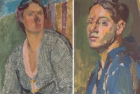
Self-portraits by the Bloomsbury painters: Vanessa Bell (around 1915) and Duncan Grant (around 1920)
Adventures with Van Gogh is a weekly blog by Martin Bailey, The Art Newspaper's long-standing correspondent and expert on the Dutch painter. Published on Fridays, stories range from newsy items about this most intriguing artist, to scholarly pieces based on meticulous investigations and discoveries.
Explore all of Martin’s adventures with Van Gogh here.
Tate Britain’s exhibition Vanessa Bell & Duncan Grant: Inside Bloomsbury, which opened yesterday (12 November), emphasises how early 20th-century British artists were inspired by Van Gogh.
Vanessa Bell (1879-1961) and Duncan Grant (1885-1978) lived together for more than 50 years in a very Bloomsbury fashion, each having other lovers. The Bloomsbury group, named after the London quarter where they lived in the early 20th century, began as an informal collective of progressive artists, writers and intellectuals.
As the Tate show’s curator, Thomas Kennedy, points out: “When Bell and Grant were doing new and exciting things, individuals like Van Gogh—who were creating something wildly different from other artists of the time—were very much an inspiration for them.”
Bell and Grant were both also very close to the art critic Roger Fry, who in 1910 curated the pathbreaking London exhibition Manet and the Post-Impressionists, inventing the term Post-Impressionism. This show introduced Van Gogh to a British audience.
Vanessa Bell’s portrait Roger Fry (1912)
As so often with the Bloomsbury group, sexual relationships were complex and intertwined. In 1907 Vanessa had married the art critic Clive Bell, but it was always an open marriage. Two years later she started a relationship with Duncan Grant, producing a daughter, and they then continued to live together.
Duncan Grant, however, was homosexual, having numerous lovers, including a male cousin and Vanessa’s brother. To add to the complications, Vanessa later had a brief relationship with Roger Fry. The quip about the group was that they were “living in squares [in Bloomsbury], painting in circles and loving in triangles”.
The Bloomsbury relationships may seem bewildering to outsiders, but the key point to bear in mind with the current Tate exhibition is that Bell and Grant shared a home for over 50 years. Initially they lived in London, and, from 1916, partly at Charleston farmhouse in rural Sussex.
It proved to be an enduring artistic partnership. They influenced each other, and they, in turn, were influenced by modern European artists, such as Van Gogh, along with Paul Gauguin, Paul Cezanne, Henri Matisse and Pablo Picasso.
The impact of Post-Impressionism: Duncan Grant's The Mantelpiece (1914) and Vanessa Bell's Still Life on Corner of a Mantelpiece (1914)
Grant, who studied art in Paris in 1906, may have then come across the work of Van Gogh. What is more certain is that Bell discovered Van Gogh in 1909, in a group exhibition at London’s New Gallery, which included a single painting by the Dutchman. She once described it as “a lovely little Van Gogh of flowers in a jug”.
The still life had been lent by Thomas Fisher Unwin, a London publisher who, with his wife Jane, had in 1896 been the first Briton to buy a Van Gogh after the artist’s death. This was a flower still life, probably one with a black background which has always been in private collections.
Van Gogh’s Bouquet of Flowers (summer 1886)
private collection (formerly Galerie Schmit, Paris)
But what was most influential for Bell and Grant was Fry's first Post-Impressionist exhibition in 1910. Including around 30 works by Van Gogh, it was the first chance for Londoners to see more than an odd painting by the artist.
This was a heady time for the Bloomsbury group. Bell later recalled: ”That autumn of 1910 is to me a time when everything seemed springing to a new life - a time when all was a sizzle of excitement, new relationships, new ideas, different and intense emotions all seemed crowding into one’s life.”
Catalogue of the second Post-Impressionist catalogue (1912), co-designed by Bell, Grant and Fry
Bibliothèque de l'Institut National d'Histoire de l'Art, Jacques Doucet collections
In 1912 both Bell and Grant had paintings in Fry’s second Post-Impressionist exhibition. They also co-designed the catalogue with Fry, and Bell helped hang the show. This time there was only a single Van Gogh, but it was again the Fisher Unwin flower still life, which Bell had known from four years earlier.
Bell, Grant and Fry all loved the south of France, where Van Gogh had also worked, and they visited regularly from the 1920s. Fry helped a friend buy a farmhouse in Saint-Rémy-de-Provence, just a few hundred metres from the asylum where Van Gogh had stayed in 1889-90. On one occasion Grant visited Bell, who had bought a house just outside Cassis, on the Mediterranean coast. Grant described the surrounding landscape as “far more extraordinary than St Remi [sic]”. Both artists were well aware of Van Gogh's connection with Provence.
How then did Van Gogh’s art inspire Bell and Grant? They never set out to simply imitate his style, but were nevertheless powerfully influenced by his work and that of the other Post-Impressionists. The two British artists began to paint with heightened colours, simplified forms and strong lines.
The links can also be seen in individual pictures. Bell’s View into a Garden (1926, Bolton Library & Museum Services) includes two empty chairs, which were probably a reflection of Van Gogh’s pair of paintings of his own chair and the armchair of Gauguin (the picture of his own chair had been bought by London’s National Gallery three years earlier, so would have been well known to Bell).
In 1911, the critic Frank Rutter described Bell’s Chrysanthemums (1920, Tate, although not in the current exhibition) as “undoubtedly influenced by Van Gogh”. Its dark background echoes the Van Gogh still life which Bell had seen some years earlier.
Decades later, in 1946, Grant wrote to Bell about visiting a Van Gogh exhibition in Copenhagen, “a splendid show”. He added: “I really feel that artists should resist to the death having their works reproduced in colour. It really has been the death of Van Gogh. It’s only when one sees the originals that one realises what a very lovely & personal colour sense he had… I really do not believe in his madness as an artist at all.” Van Gogh remained in the minds of the couple for the rest of their lives.
Martin Bailey is a leading Van Gogh specialist and special correspondent for The Art Newspaper. He has curated exhibitions at the Barbican Art Gallery, Compton Verney/National Gallery of Scotland and Tate Britain.
Martin has written a number of bestselling books on Van Gogh’s years in France: The Sunflowers Are Mine: The Story of Van Gogh's Masterpiece (Frances Lincoln 2013, UK and US), Studio of the South: Van Gogh in Provence (Frances Lincoln 2016, UK and US), Starry Night: Van Gogh at the Asylum (White Lion Publishing 2018, UK and US) and Van Gogh’s Finale: Auvers and the Artist’s Rise to Fame (Frances Lincoln 2021, UK and US). The Sunflowers are Mine (2024, UK and US) and Van Gogh’s Finale (2024, UK and US) are also now available in a more compact paperback format.
His other recent books include Living with Vincent van Gogh: The Homes & Landscapes that shaped the Artist (White Lion Publishing 2019, UK and US), which provides an overview of the artist’s life. The Illustrated Provence Letters of Van Gogh has been reissued (Batsford 2021, UK and US). My Friend Van Gogh/Emile Bernard provides the first English translation of Bernard’s writings on Van Gogh (David Zwirner Books 2023, UKand US).
To contact Martin Bailey, please email vangogh@theartnewspaper.com
Please note that he does not undertake authentications.
Explore all of Martin’s adventures with Van Gogh here