 ewsba.se
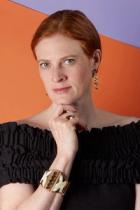
Cora Sheibani wearing jewellery from her own collections: a bronze bracelet (from Pottering Around collection), Renaissance earrings in platinum and a sapphire facet ring in 18K red gold (both from Facets & Forms Collection)
Art of Luxury magazine, published twice per year by The Art Newspaper, explores how grande marque fashion, jewellery, travel and lifestyle interact with artists, the art market and the museums and heritage sector.
The jeweller Cora Sheibani lives in London and works from a small studio in Mayfair. She was raised in the art world—her father was the celebrated Swiss dealer Bruno Bischofberger, who collaborated with artists including Jean-Michel Basquiat, Andy Warhol and Francesco Clemente. As a dyslexic, Cora did not embrace reading as a child, but now she explains why it is her window on the world.
For me, luxury is about having time. As you get older, and as the world gets faster, there’s never enough of it. In an ideal world I would travel more, both for work and for pleasure; and visit exhibitions, galleries and museums. But I also have a son who needs a lot of my attention—he is very autistic, with severe ADHD—and so I travel through books, and reading has become a way to experience culture, art and creativity.
I’m lucky to have grown up around artists and people who didn’t follow the conventional path. Francesco Clemente is a close family friend, and his daughters are more like my cousins. We’re close to the Schnabel family; Jean Tinguely was my sister’s godfather. So even though I barely read as a child—it was just too hard—I made myself study liberal arts before I became a jeweller. Only after university I started reading German literature. It’s my mother language, after all.
I’ve always loved jewellery. When I was 15, I worked in my parents’ gallery over the summer, and spent half my earnings on two rings, both bronze, one Greek, one Roman. Now I work primarily with gold: at first it was because yellow is my favourite colour, but you also learn that gold is the friendliest metal to handle.
It was hard to be taken seriously as a jeweller at the beginning. People thought it was a hobby, and I really had to be patient and persevere—that’s something I can do, that dyslexia taught me. Now I’m incredibly proud of my work and how successful the business has become.
Jewellery books and especially exhibition catalogues are a real inspiration. An essay by Amin Jaffer in the catalogue for Joyaux Dynastiques, a show at the Hôtel de la Marine in Paris last year of royal jewels, explained the meaning of a particular kind of nine-gem Indian jewel. It really helped me with a commission I’d just received from a client for a piece using nine different coloured stones.
I buy some early editions from Shapero Rare Books in Mayfair—I pass it every time I go from the gym to the studio and can’t resist taking a look. I just finished reading Crime and Punishment by Fyodor Dostoyevsky in its first English translation by Frederick Whishaw. It’s very rare, a real collector’s item. It’s generally thought that translations have improved, but there’s something special about reading a contemporaneous one. It’s a rich experience that takes you back in time.
Once a month, I get together with my book club. There’s only three of us, and we don’t all have to read the same book. Instead, we talk about what we are each reading. We meet, usually on a Friday morning, at Daria Buchman’s house, and have a breakfast of scrambled eggs. Daria, with her husband Dimitry, sponsors the International Booker Prize, so she is really on top of every new novel. She hadn’t read Beloved by Toni Morrison, though. I’d read three works that talked about slavery from different regional angles—Beloved, Crooked Plow by Itamar Vieira Junior and Ben Okri’s The Last Gift of the Master Artists—and recommended to my group they did the same. You begin to understand a bit better how the lives of people from one continent evolved in such different (and at times similar) ways. On the other hand, Daria made me read the wonderful Wuthering Heights. I wouldn’t have done it if she hadn’t insisted.