 ewsba.se
Nearly 200 countries have arrived on Türkiye's Mediterranean coast for a climate summit with a different ambition: fewer grand declarations and more concrete decisions. With a powerful El Niño threatening to worsen extreme weather, negotiators face difficult questions over climate finance, clean energy and how to protect communities already living with the consequences of climate change.
The Mediterranean city of Antalya is no stranger to history. Greeks, Romans, Byzantines and Ottomans have all left their mark on this stretch of Türkiye’s southern coast. Now, as nearly 200 countries gather here for the latest UN climate summit, COP31, the question is whether they can add a new chapter of their own by turning decades of climate promises into action.
Inside the vast conference venue, the Turkish tulip featured in the COP31 logo is a recurring sight as participants navigate long corridors leading to national pavilions and negotiating rooms.
Beyond the bustle of the conference halls, the stakes are high. As extreme weather impacts mount worldwide, governments face growing pressure to show that decades of climate commitments can deliver results.
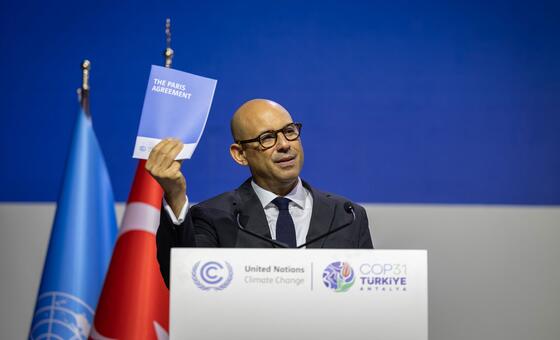
“Progress is nowhere near far enough or fair enough,” UN Climate Change chief Simon Stiell told the opening plenary on Monday, urging countries to move beyond setting targets and “supercharge solutions” that can make a difference on the ground.
“No COP is a silver bullet. No single conference can bridge the chasm between the science and reality,” he said.
Unlike summits dominated by a single landmark agreement, COP31 is focused on turning existing commitments into action.
Türkiye’s Environment Minister Murat Kurum officially took the gavel this morning as the COP31 President, while Australia’s Climate Change and Energy Minister Chris Bowen will oversee negotiations under an unusual co-presidency arrangement agreed during COP30.
“Our decisions must take shape in a city’s infrastructure, on a farmer’s land and along a factory's production line. Families must feel their impact in lower energy bills,” Mr. Kurum told delegates.
Mr. Bowen announced plans to develop a presidency-led decision throughout the conference, rather than waiting until its final days. The aim is to agree on practical measures to accelerate climate action, although differences remain over how ambitious the outcome should be.
Finance is expected to be the one of the toughest issues, with developing countries seeking faster access to funding for adaptation and cleaner development. Negotiators must also advance agreements on emissions reductions and a just transition.
“We know there will be a difference of views – on the value of the decision, on its elements, on how far we go. But our job is to work to close those differences and provide the most ambitious, most outcome-orientated decision that consensus will allow,” Mr. Bowen explained.
Monday was also Food, Agriculture and Health Day, bringing attention to the growing toll of climate change on human health.
According to the World Health Organization (WHO), between 3.3 and 3.6 billion people live in areas highly vulnerable to climate change. Extreme heat, floods and shifting weather patterns are already putting lives at risk and straining health systems worldwide.
“The main character at the center of this story is not the atmosphere. It's not the land, the ocean or the ice. It’s us. You and me, our family and our communities,” Alan Dangour of the Wellcome Trust Foundation said during a press conference by the World Meteorological Organization (WMO), urging climate negotiators to put people at the heart of their decisions.
“We cannot adapt to an unmitigated future,” Mr. Dangour warned.
Extreme heat offers a particularly troubling example. Scientists are increasingly concerned about links to premature births and stillbirths, while outdoor workers, children and older people face particular risks.
Joy Shumake-Guillemot, of WMO, explained to UN News how meteorologists and health professionals are working together to reduce some of those risks.
Through a joint initiative with WHO, climate information is being brought into public health planning. A forecast of dangerously high temperatures, for example, can help hospitals prepare for more patients, while rainfall and seasonal predictions can help health authorities anticipate outbreaks of diseases such as malaria.
The main character at the center of this story is not the atmosphere. It’s not the land, the ocean or the ice. It’s us – Alan Dangour, Wellcome Trust Foundation
“The weather information is very practical, it is directly relevant to the decisions being made in the health sector, but they often don't have access to it,” she said.
And the potential is enormous: “From a public health perspective, almost all heat deaths are actually preventable,” Ms. Shumake-Guillemot said.
Health is one of the 10 priority areas of COP31’s Action Agenda, and countries are being urged to put into practice the Belém Health Action Plan agreed at COP30. A new Antalya Initiative for Health Resilience is also being launched.
Food and agriculture account for roughly one third of global greenhouse gas emissions. But the sector is also highly vulnerable to climate change, as rising temperatures, droughts and floods threaten crops and the livelihoods of millions of farmers.
Agriculture can also be part of the solution. Cristian Barrasueta, from the World Rural Forum, told UN News that farmers are already putting some of these approaches into practice. In Fiji, for example, families are experimenting with different crop varieties and finding ways to protect their seedlings from increasingly powerful cyclones.
Their role is also being discussed at COP31, where countries are reviewing the Sharm el-Sheikh programme on agriculture and food security (COP27) and deciding what comes next.
For Mr. Barrasueta, the priority is ensuring that family farmers have a say in shaping climate policies and can access the funding needed to adapt. Currently, he explained, complicated procedures and multiple intermediaries make international climate finance difficult to reach, particularly for small farming organizations.
The urgency is already evident in Bolivia, where a severe drought has prompted the government to declare a national emergency. More than 75,000 head of livestock have died and over 114,000 families have been affected, according to official figures.
With El Niño expected to intensify in the coming months, Mr. Barrasueta warned that farmers need support now, not after years of planning and paperwork.
His message echoed some of the main themes from COP31’s opening day, where UN agencies also issued stark warnings about the potential impacts of El Niño.
Follow the latest developments from COP31 through our new podcast, Talk & Action, and our special daily coverage of the conference.