 ewsba.se
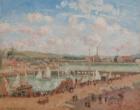
Camille Pissarro's Darse de pêche et bassin Duquesne (fishing dock and Duquesne basin, 1902)
A French court has ordered the cancellation of the Sotheby’s London sale of a landscape by Camille Pissarro, and its immediate restitution to the heirs of Jewish banker Salomon Flavian, on the grounds that it was looted in Paris in 1941. According to the 5 November ruling, Sotheby’s has two months to reveal the “complete identity” of the buyer, subject to a daily penalty of €1,000 for any delay.
Entitled Darse de pêche et bassin Duquesne (fishing dock and Duquesne basin, 1902), this view of the port of Dieppe in Normandy, was sold at Sotheby’s London on 25 June 2024 for £1.2m.
The Sotheby’s catalogue did mention it had been owned by Flavian from 1935 and was registered in the Répertoire des biens spoliés (repertory of looted art) released by the French government in 1947. Nevertheless, it indicated that the work was “offered for sale pursuant to a settlement between the current owner and heirs of Salomon Flavian”. Their consent, Sotheby’s explained in court, had been obtained by the Mondex Corporation, a Toronto-based company specialised in the return of looted art.
At a court hearing on 18 September, Corinne Hershkovitch, the lawyer for seven heirs of Flavian, said this agreement had been signed by only two relatives and the others were not consulted. In court, Mondex and Sotheby’s endorsed a study which concluded that the painting had been acquired in the late 1930s by the British artist and collector Edward Le Bas, from the dealer Paul Rosenberg, and therefore was no longer part of Flavian’s collection seized in 1941 by the Nazis.
The court judged otherwise, considering that there was “no direct and convincing evidence” of these alleged transactions. On the contrary, the Flavian family’s research produced “a set of precise, serious and concurring elements demonstrating that Pissarro’s work was indeed looted during” the Second World War, according to the judges.
In a statement, a spokesperson for Sotheby’s London said it is “disappointed by the judgement regarding the restitution”. However, the auction house “welcomes the decision to dismiss all claims against Sotheby’s”. “The history of the artwork is complex”, the spokesperson adds, and “we fully recognise the profound losses suffered by the Flavian family during the Nazi era and, from the outset, have approached this matter responsibly and with the care and respect it deserves.”
“It is a very important ruling, which opens the way to a restitution that the Flavian family has demanded since the war,” Hershkovitch tells The Art Newspaper. “It shows Mondex’s failure in its mission, and now Sotheby’s has to bear the responsibility for having sold a looted artwork.”
Mondex’s lawyer, Melina Wolman, says the company intends to appeal a judgement that, she says, is “posing major difficulties in regard with historical factors”. She adds that the name of Le Bas, who owned the Pissarro painting in the 1950s, appears on an entry in the catalogue raisonné edited by Paul Rosenberg in 1939. But the court ruled that this was only one among “contradictory elements” and that Sotheby’s and Mondex “did not support this hypothesis by any direct proof of such sales, at a time when France was at peace and the art market well structured”.
In court, Remi Sermier, a lawyer for Sotheby’s, also disputed the court’s jurisdiction on a sale made in London. But the court stated that, under French law, the annulment of the 1941 dispossession acts makes all subsequent sales of the work null and void. However, the court chose not to cancel the agreement signed between Mondex and the two heirs who had waived all their rights to the painting just before the sale, in exchange for a share of the sale price.
The ruling could trigger a cascade of ligitation internationally. Sotheby’s is “considering whether to join the appeal”, a spokesperson says, stressing that “client confidentiality is of paramount importance” for the company and it is not ready to willingly disclose the identity of the painting’s buyer. The spokesperson adds: “There is a procedure that will need to be followed in order to enforce the decision in the UK.”
In case of success, the Flavian family will have to face the current possessor, who can demand compensation from Sotheby’s. For its part, the auction house could turn against Mondex and the consignor of the work, because, according to sources close to the case, the settlement agreement Mondex and the seller signed contains an indemnity clause of which Sotheby’s is the beneficiary.