 ewsba.se
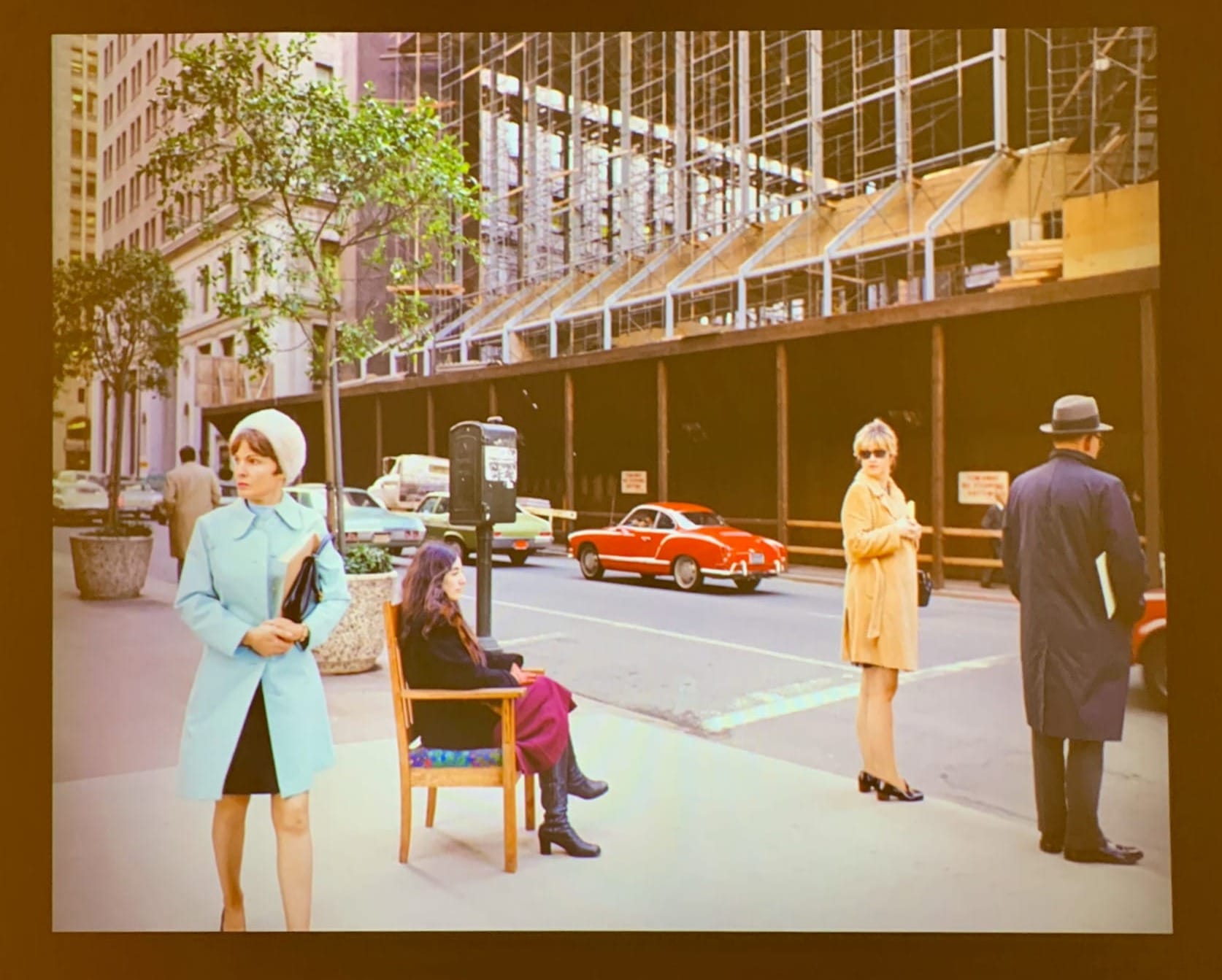
California performance artist Bonnie Ora Sherk was a cultural trickster and proactive spoiler in the business of everyday life.
SANTA BARBARA — People didn’t always live in cities. It became more of the norm as asphalt and concrete covered dirt, and highways and overpasses became the infrastructure for commuting and delivering food and supplies. Bonnie Ora Sherk (1945–2021) spent four decades as an artist, landscape designer, and educator challenging the assumptions that underpin city life. Through her creative projects, Sherk consistently proposed new models of social relations. The retrospective Life Frames since 1970 at the University of California, Santa Barbara’s Museum of Art, Design, and Architecture, is a well-designed, if modest, exhibition that highlights many of her interventions, from performances to interactive engagements, as documented in drawings, posters, photographs, and moving images.
Sherk began as a cultural trickster, like many conceptually based artists from the late 1950s onward, often acting as both observer and observed — and proactive spoiler — in the business of everyday life. After studying with Fluxus artists Robert Watts and Mel Henderson, Sherk applied a post-Dadaist performance sensibility to visionary yet practical rethinking of human priorities, promoting mindful encounters with other living creatures.
Because much of the exhibition is documentary, the aesthetics are somewhat limited, with occasional visual pleasures. Set in mundane outdoor locations in San Francisco, Sherk’s series Sitting Still (1970) — in which the artist places herself in ordinary chairs amid daily urban life — is presented in the exhibition through projections of large-scale Kodachrome photographs. Nearby, a black-and-white film transferred to video documents “Public Lunch” (1971), projecting Sherk caged in the San Francisco Zoo’s Lion House next to big cats in a neighboring lockup, as visitors gawked while both cats and the artist paced, napped, and were fed.
Around the same time, she began creating pop-up spaces around the city under the umbrella title Portable Parks I-III (1970). Set above and below active highway overpasses or in busy downtown alleyways, these public "parks" held livestock and cultivated plants. This culminated in an early peak with Crossroads Community (aka The Farm) (1974–80), where Sherk catalyzed social possibilities through sustained interactions and shared knowledge about animal husbandry and urban homesteading, along with an array of musical and experimental performances by numerous artists.
Resonant with diverse back-to-the-land initiatives in the 1960s and '70s — and a feminist contrast to Land Art’s distant locations and monumentality — Sherk’s divergent vision insisted on staying with the city, offering alternatives to how urban spaces were organized and focusing on neglected, under-resourced communities. These interventions opened the door to a swirling proliferation of anarchistic community access and cultural production, while pushing the frame of what might be considered conceptual art practice. Much recurrent activity at The Farm emerged under the rubric “T.R.E.A.T.” for “The Raw Egg Animal Theater” – a typical bit of serious whimsy on Sherk’s part that named an open-ended interactive staging ground for plants, humans and other animals. Over the years, thousands participated in programs at The Farm, accessing ideas, information, and other living creatures they would not otherwise have encountered.