 ewsba.se
The latest on the student protests in France, the art world’s AI problem, one-on-one with Rosana Paulino, and Beer With a Painter featuring Melissa Brown.
The subway car rattles, shakes, and screeches as it tunnels us from Brooklyn to Manhattan underneath the East River. I hold on tight to a pole, while my eyes are fixed on an ad for the Broadway musical Les Misérables.
My social media feed shows me only looting and vandalism in France, painting a violent picture of the largely peaceful student protests. Panicking, the art world’s blue-chip class shuts down Art Basel Paris early and flees the city. The Louvre also closes to protect its treasures. Loot a little and they throw you in jail; loot a lot and they let you open a museum.
I get to a benefit dinner for an art residency held in a former bank. A peppy auctioneer asks the who’s who to open their hearts and wallets. Paddles go up and down, and a donation ticker on a big screen climbs to astronomical numbers while I admire the building’s huge stained-glass skylight. Up there, near a golden clock that no longer ticks, an inscription in marble letters reads, "It's what we save rather than what we earn that ensures a competence for the future."
Outside, Midtown Manhattan is huffing and puffing, and the neon lights glow too bright. A sign in a bodega window advertises that the Powerball jackpot has hit $650 million, and I drift into a daydream about what my life would be like if I won that much money. I picture myself raising the paddle at auctions and amassing a serious art collection — just to support artists, you know.
I sit somewhere for a coffee and see the barista trying to buy a ticket on her phone for a new movie about white-collar convicted criminal Elizabeth Holmes, who’s become a cultural icon among the petite bourgeoisie. The barista can’t find a ticket because the theater is sold out.
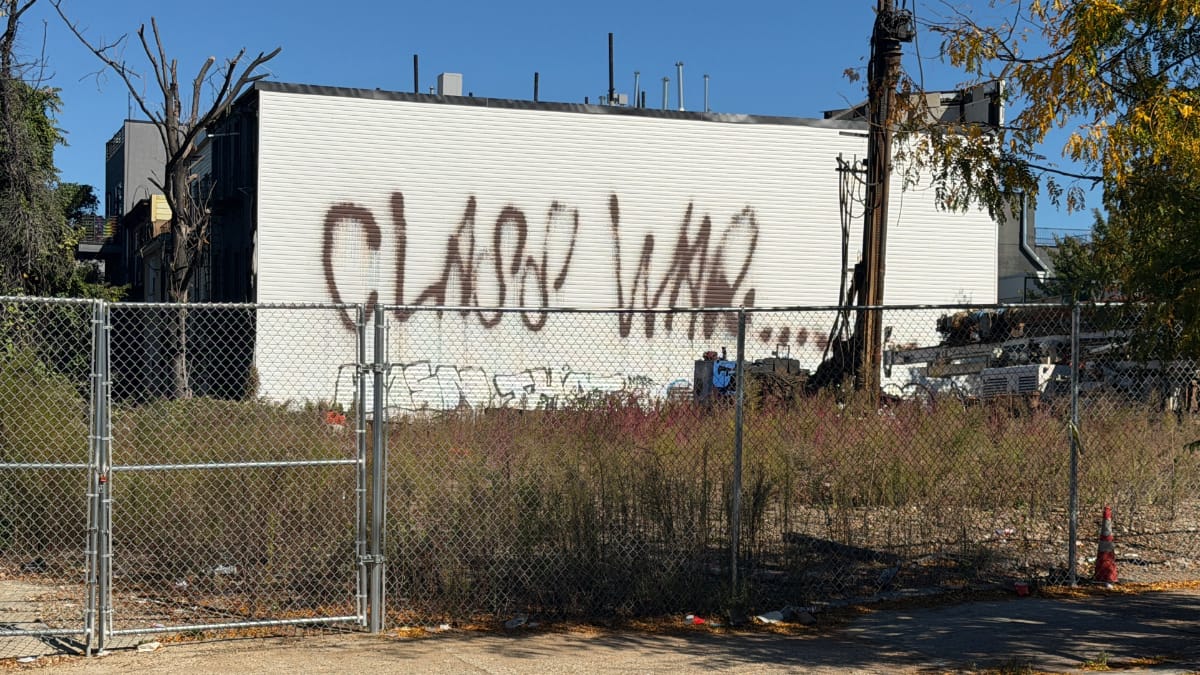
On the subway ride back home, I get sucked into an essay about Kazimir Malevich’s concept of the “White Abyss” and miss my stop by several stations, adding an hour to my commute. I get off in an impoverished neighborhood and see that someone has graffitied “Class War” all over a residential building. There’s nothing open but a convenience store at a gas station. Fuck it, I’m buying a Powerball ticket.
Wall labels. Press releases. Artist statements. In today’s fast-paced art world, the written word stands at a crucial crossroads — and the stakes have never been higher. But here’s the thing: It’s not just about convenience. It’s about authenticity. Because the way we express ourselves matters.
The above paragraph was generated by Claude when prompted to write an introduction for an opinion piece against AI use in art writing, and if it made you recoil in your seat, you may be among those of us who have developed a strong aversion to generative text. You’ll know it when you see it: that uncanny cadence that’s overconfident in style yet hollow in substance, like a motivational LinkedIn post that feels relatable at first but leaves you with as much nourishment as a spoonful of Stevia. | Valentina Di Liscia
Old Master Through Modern Prints at Auction This Week
Swann’s premiere print sale on October 29 will showcase a carefully considered selection of works that reflect the breadth and timelessness of the printmaking practice—from refined impressions by early masters such as Albrecht Dürer and Rembrandt van Rijn, to trailblazing modern artists like Maurits C. Escher and Marc Chagall.
The beauty of the Native artist’s forms seduces, but the visual history of destruction is embedded into each element. | Hrag Vartanian
He brought his optical preoccupations into the 21st century, without losing his love of artists from earlier eras. | John Yau
An exceptional exhibition that brings together 17 women artists whose work emerges through spirit communication. | Eliza Swann
The exhibition shapes a fashion canon based less on historical relevance than on the interests of those in charge. | Natalie Haddad
“The Prime of Your Life” examines what recognition and market success mean for 18 women artists over 75. | Leah Triplett Harrington
Fred Camper’s contemplative film “Suicide Note” was born out of grief and a city in collapse. | Dan Schindel
Join us on October 28 in Brooklyn, NY for an evening of spooky cocktails, devilish delights, an art-themed costume contest, and more.
The Los Angeles-based photographer, who was raised in a conservative Catholic environment, is reclaiming the divinity of queer and trans identity through religious imagery. | Emma Cieslik
Santa Paws, Vincent van Doge, and the papal Pup Leo were among this year’s fierce competition. | Anna Lee
The musician and indie darling was drawn to John Griswold’s intimate tableaux evoking Renaissance and Baroque iconographies. | Sophia Lebowitz
“I want to visualize the fact that, despite our perception, reality is changeable,” the Brooklyn-based artist said of her paintings. | Jennifer Samet
“This history is dirty,” says the Brazilian artist, who sees the colonial past as an active force in her country’s present. | Daniela Mayer
This week, we honor a fixture of New York and New Delhi art, a painter who folded the world into abstraction, and a champion of Denver’s scene.
“My past sculptures [and] tools act as levers that pry ideas from my mind.”