 ewsba.se
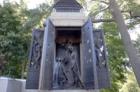
Gertrude Vanderbilt Whitney’s bronze tableau at the Untermyer Memorial, Woodlawn Cemetery, the Bronx Photo: Allison C. Meier
Bronze sculptures created by Gertrude Vanderbilt Whitney for the Untermyer Memorial are among New York City’s most evocative outdoor works of art. Yet nestled in a corner of the Bronx’s Woodlawn Cemetery, they have largely been overlooked. A recent restoration of the memorial supported by the Untermyer family is bringing new attention to its design by Paul Chalfin, best known for his opulent work at Miami’s Villa Vizcaya, as well as to Whitney’s sculptures.
Whitney, who is herself buried at Woodlawn, had a successful career as a sculptor that is often eclipsed by her patronage and collecting of American art in the early 20th century, particularly her founding of the Whitney Museum of American Art. In her creative practice, she was inspired by the expressiveness of Auguste Rodin, the bold realism of Modernism and the forms of the ancient world.
At the Untermyer Memorial, she created three life-size figures that are elevated within a granite structure with metal doors opening on three sides. It marks the entrance to the plot, one of the cemetery’s largest.
“You get this feeling of ascension, because there’s a sloped hillside, there’s a staircase on one side and you see this tower with a mother figure ascending up to the heavens,” Meg Ventrudo, the executive director of the Woodlawn Conservancy, tells The Art Newspaper.
The meaning of Whitney’s trio of figures is ambiguous. It is sometimes interpreted as representing different stages of a woman’s life or the crossroads of life and the afterlife. One figure turns to gaze down at the viewer, another is on their knees reaching towards the third, who soars upwards with arms lifted.
The metal doors that hide or reveal this tableau are decorated with flowers on the interior and allegorical scenes on the exterior, like a mother holding her baby and a nude woman and man whose bodies sway together. “It’s beautiful and comforting, but sad at the same time,” Ventrudo says. “To capture those conflicting emotions is really amazing.”
Adrian Untermyer speaks at the restoration’s ribbon-cutting Photo: Johnathan Clemente
The memorial’s restoration started in 2024 and had its ribbon-cutting on 3 October. Overgrowth that had hidden the side entrance and imposing rough-hewn wall was removed, and new plantings were added to follow the original design, with magnolias, holly and ferns joining century-old survivors like a pair of tulip trees and a large Atlas blue cedar.
A long, stone whispering bench with paw feet was cleaned, and a bronze fountain adorned with griffins was removed and restored, while the bluestone Star of David it rests upon was entirely rebuilt—having fractured into shards over the years.
Samuel Untermyer, who was Jewish, was a prominent lawyer whom the press called “Hitler’s Bitterest Foe” for his leadership in anti-Nazi Germany boycotts in the 1930s. He had a passion for horticulture that can still be seen in the eclectic gardens at his former estate in Yonkers, New York, which have themselves been undergoing restoration since the formation of the Untermyer Gardens Conservancy in 2011. He and his wife, Minnie, were both patrons of the arts, and Samuel commissioned the Woodlawn memorial after Minnie’s death in 1924.
The Untermyer Memorial succeeded naturalistic portraiture busts and major public monuments such as the Inwood memorial to the First World War, which similarly features the interplay of three figures.
Whitney was already connected with Chalfin before this collaboration, with the designer working on her Long Island studio. His design for the Untermyer plot has a “U” shape, curving through generations of interred family members, then swooping along the whispering bench and down terraced, grassy stairs. The memorial is still used by the Untermyer family.
“We’re hoping that not only is it an attractive place for our family members to rest, but we’re also looking forward to having it be a wonderful greenspace for the people of the Bronx,” says Adrian Untermyer, Samuel’s great-great-grandson and a preservationist central to the restoration partnership between his family and Woodlawn. “You can have a quiet moment or a joyful moment up there.”
The care for the thousands of monuments at Woodlawn, which include works by leading artists of the 19th to 21st centuries, is always ongoing. Restoration is now underway on an open-air Tiffany Studios mosaic, and a survey is in progress of the cemetery’s stained-glass windows. As Ventrudo says: “Woodlawn is an outdoor museum, and it’s the individuals in our care.”