 ewsba.se
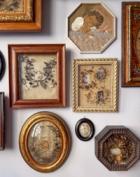
Examples of hairwork at the Morbid Anatomy Library in Brooklyn Courtesy Morbid Anatomy
During the Victorian era, people would clip locks of hair from loved ones (whether alive or awaiting burial) to weave and twirl into commemorative objects known as hairwork. Around 50 of these keepsakes, ranging from tiny necklace charms to wreaths framed in gilded shadowboxes, will go on long-term public view on 27 September at the Morbid Anatomy Library in Brooklyn, New York.
Many pieces in the non-profit institution’s collection, which fills a gallery wall and vitrines, have photos and handwritten notes with the names, hometowns and death dates of the toddlers, newlyweds and grandparents who supplied the strands, braids and ringlets. There are also longer inscriptions, such as “In memory of my deeply mourned parents” and “I am waiting for you in heaven”.
The hair, in hues from flaxen to charcoal, has been knotted into the shape of flowers, foliage, berries, butterflies, lyres, crowns, horseshoes and crosses. The makers added multimedia touches to the assemblages: glittery beads, metallic thread, ribbons, feathers, fabric petals, cotton balls, portraits of Christian saints and, heartbreakingly, barely worn baby booties. Museumgoers may find themselves disconcerted by their own reflections in the glass enclosures, as if their images were entangled with the three-dimensional traces of the deceased.
Example of hairwork at the Morbid Anatomy Library Courtesy Morbid Anatomy
The Morbid Anatomy Library obtained this unique collection from Leila’s Hair Museum, a recently shuttered institution in western Missouri founded by Leila Cohoon—a hairdresser and hairdressing instructor who died in 2024. Starting in the 1950s, Cohoon travelled widely to amass around 3,000 hairwork antiques, which she hung floor to ceiling in her museum’s freestanding building flanked by strip malls. She also researched how hairwork was traditionally made, and she taught classes to revive Victorian techniques and published writings on the subject.
Karen Bachmann, a hairwork historian and teacher, describes Cohoon’s museum as “the Louvre of hairwork”, where “the variety and the volume were outstanding”.
Cohoon’s granddaughter Lindsay Evans has been dispersing the collection in the form of donations to dozens of organisations nationwide as prominent as the Metropolitan Museum of Art, American Folk Art Museum and Smithsonian National Museum of American History. Bachmann and Joanna Ebenstein, Morbid Anatomy’s founder and creative director, travelled to Missouri to select acquisitions in collaboration with Evans.
Example of hairwork at the Morbid Anatomy Library, Brooklyn Courtesy Morbid Anatomy
Ebenstein explains that the goal was to assemble a Brooklyn microcosm of Cohoon’s broadmindedness, juxtaposing elaborate sculptural constructions and simple hair snips encapsulated in jewelry, glass domes and dioramas. Morbid Anatomy’s displays now represent how much hairwork “was a part of everyday life”, Ebenstein says.
Morbid Anatomy brought in Dave Herman, the founder of Brooklyn’s City Reliquary museum, and his wife, Shannon Herman, to transport Evans's gifts from Missouri to New York. The Hermans packaged each example in custom foam enclosures for the long drive. As the couple pulled away from the Cohoon site, tornado clouds darkened the sky behind them, which eerily suited the mourning aspects of the hairwork. “We just kept flooring it going east,” Dave Herman says.
Evans notes that although it is bittersweet to dismantle Leila’s Hair Museum, the scattered collection will now be accessible to millions of museumgoers across the US. And the Morbid Anatomy installation, she adds, “looks just like my grandmother’s museum—she’d love it”. Evans says that what her grandmother most wanted “was for these pieces to be seen and appreciated, and loved as much as she loved them”.